
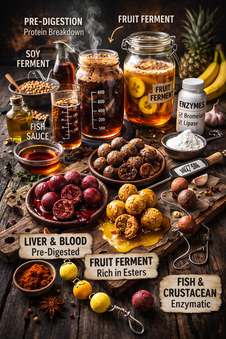
Fermentation and pre-digestion are two terms that describe the breakdown of food carried out by microorganisms (bacteria), fungi (yeasts), or enzymes
(proteins).
In practical terms, it is an evolution that could be defined as degeneration or even putrefaction — the key difference
being that it happens in a controlled environment, without the formation of toxic or harmful compounds.
These are NATURAL processes that mankind has learned to control and guide over centuries, because they are fundamental for the long-term preservation of certain foods. They are natural because they occur spontaneously, although they can be accelerated and directed using specific substances known as starters.
The basis of the process is determined by four fundamental factors:
-
A suitable substrate, meaning the starting material (ripe, sugary fruit; meat; fish; milk, etc.)
-
A suitable starter (yeasts, bacteria, enzymes)
-
The correct temperature (never below 20°C, ideally between 30 and 38°C)
-
The time factor, which is inversely proportional to temperature
The term FERMENTATION is more appropriate when referring to transformations of plant-based materials. Classic examples include lactic fermentation (as in kimchi), acetic fermentation (fruit vinegar), bacterial fermentation of soybeans to produce natto, and all the processes carried out by brewer’s yeast on starches.
All fermentations are also forms of pre-digestion, because bacteria and yeasts break down the nutrients present in plant matter — mainly sugars and proteins, since plants are generally low in fats — transforming them into primary, highly attractive and water-soluble substances such as esters.
At the same time, fermentation causes a significant increase in flavour, enriching the original material with
organic acids and enhancing palatability (just think about pickled vegetables).
These factors are extremely interesting for fishing, because they amplify attraction through water-soluble
channels that fish can easily detect, while also adding taste and palatability to our baits, encouraging confident feeding by carp.
One of the most appreciated DIY recipes from my books and online content is fermented banana, used to create an excellent
substitute for synthetic flavours.
Technically speaking, it is a banana vinegar, although in angling it is often referred to as a liquid food, a term well known among carp anglers.
Bananas are unique fruits because they undergo a natural and spontaneous internal transformation during ripening. When unripe they are rich in starch, while during
ripening starches are converted into sugars — a process that is already, in itself, a form of fermentation.
The ideal moment is when the peel is completely brown, the flesh has turned yellow/orange, and the smell begins to develop acidic and alcoholic notes.
The process is simple: blend the banana including the peel, add one glass of unpasteurised vinegar as a starter (useful but not strictly essential), and leave it to ferment for at least 7–10 days in a warm, dry place (above 20°C).
At this point, the liquid can be further personalised by adding:
-
fermented garlic paste (whole cloves can also be added during blending),
-
selected essential oils, both spicy and floral (cardamom and ylang-ylang are highly recommended),
-
or a primary ester such as isoamyl acetate, to reinforce the ripe banana aroma.
Fermented liquids are generally very stable, even without specific preservatives. The process can be slowed almost to complete stability by bottling the liquid in dark glass bottles (recycled olive oil bottles work perfectly) and storing them in a cool place.
Not all fruits and vegetables are suitable, especially those low in sugars. This can be corrected by adding sugar at the beginning of the process — for berries (blackberries, raspberries, cherries, etc.) a 10% sugar addition by weight is recommended.
If a chemical stabiliser is required, the most suitable option is sodium benzoate, used in just a few grams per litre.
All soy fermentations — which produce some of the most powerful carp attractors — rely on specific starters that can be purchased ready-made (see the video on natto preparation).
For those who want to explore this topic further, I highly recommend the book “The Art of Fermentation”.
PRE-DIGESTION
Pre-digestion is a much more serious matter, requiring a minimum level of knowledge and proper control of the production process, including suitable containers and tools capable of maintaining precise temperatures.
Unless you intend to produce large quantities of garum slowly, over several months.
Garum was the first pre-digested product I covered in my books and began using in the late 1990s, after discovering Asian fish sauces. (RECIPE HERE)
The process is very simple, provided you respect the 20% salt ratio, which is ESSENTIAL for process stability.
Blend whole fish INCLUDING THEIR VISCERA, adding salt (200 g per kg of fish), then leave the mixture to mature in
a suitable container for up to 12 months.
Commercial squid brand fish sauce is matured for 24 months in clay jars under the sun.
You can use almost any fish (in this season, trout from commercial lakes are very popular), whole cuttlefish with ink sac, and crustaceans such as signal crayfish or blue crab.
Garum is produced through AUTOLYSIS, because the necessary enzymes are naturally present in the animal’s viscera,
along with environmental bacteria.
Of course, faster pre-digestion can be achieved by adding enzymes, controlling temperature, and introducing
bacteria via unpasteurised vinegar, which also supplies esters and lowers pH, accelerating enzyme activity.
ONE PROCESS DOES NOT EXCLUDE THE OTHER — in fact, combining them creates the conditions for faster and sometimes slightly different results, though identical in substance.
The most commonly used enzyme for pre-digesting protein-based materials (meat, liver, kidneys, spleen, glands, blood, animal meals) is BROMELAIN, which can now be purchased in pure form.
For fats, LIPASE is used, an enzyme widely available in the dairy industry.
Those who have followed my work for many years may remember that in the early days and in my books I suggested crushing human digestive enzyme tablets or Indian meat tenderisers — simply because in the 1990s I had no access to pure enzymes and had to improvise as a true self-maker.
Enzymes are INDISPENSABLE when pre-digesting materials that do not naturally contain them (such as liver or blood meal), although they can always be added to speed up any process.
The standard dosage is 5–10 g of pure enzyme per kg of product, allowing you to obtain a pre-digested liquid suitable for boilie mixing in just 24–48 hours, provided the temperature is kept between 30 and 40°C.
To be clear: at temperatures between 20 and 30°C, processing times can increase up to tenfold.
Examples:
-
Pre-digested liver: blend 1 kg liver with 200 g salt and 10 g bromelain, 24 hours at 35°C.
-
Pre-digested blood: liquefy 1 kg blood meal with 200 g salt and 10 g bromelain.
Clear enough?
How do I liquefy fishmeal, blood meal, meat meal, or crustacean meal?
Simply with water — but since you’re doing it anyway, vinegar is a much better choice. It offers several advantages, including allowing you to reduce salt to
10%, as acidity improves preservation and stability.
Can I mix different materials together?
Of course. For example: blend 500 g raw liver, 500 g blood meal, 100 g salt, add enough vinegar to liquefy the mixture, plus 10 g bromelain.
How do I maintain temperature in winter?
The best option is an electric yoghurt maker, though it limits quantities to about 1 kg.
Alternatively, use a water bath heated to 30°C with aquarium heaters, placing your container inside. This solution — developed by my friend Stefano Negretto, whom I
thank — allows much larger volumes. Heated fermenters of 10–50 litres are also available, but generally expensive.
Are the resulting liquids stable long-term?
Absolutely — provided they are stored in dark glass containers, in a cool, dark place.
Nothing prevents further customisation with powdered spices or, better still, essential oils.
For those who want a no-nonsense, devastating final recipe, here it is:
-
700 ml bottle of Tiparos fish sauce
-
380 g pack of fermented shrimp paste
Gently warm the fish sauce in a large pan, add the shrimp paste, blend until homogeneous, then transfer to a dark glass bottle.
This super liquid food is an absolute weapon, dosed at 100–200 ml per kg on 50/50 mixes, birdfood mixes, light fishmeals and even nut-based mixes.
I hope I’ve cleared up all doubts regarding this fantastic family of high-performance attractors.
For further curiosity and in-depth guidance, I invite you to get in touch directly via the consultation form on the blog.
Discover the science behind carp bait design. Get the book here.