This article outlines a complete bait strategy designed for fast-paced fishing and competitive scenarios, based on a single base mix that can be processed into boilies, pellets, and ball pellets by modifying only a few components and production steps.
The key advantage of this approach lies in bait synergy: all feed elements share the same sensory signature while
differing in solubility and persistence.
This allows the angler to present the carp with a coherent feeding signal, composed of highly soluble particles,
medium-solubility feed, and structured baits, all speaking the same “language”.
The result is a controlled yet aggressive feeding response, particularly effective under time constraints and high fishing pressure.
Applicability Beyond Match Fishing
Although this system is primarily designed for fast sessions and competitions, it also performs exceptionally well in traditional fishing combined with pre-baiting.
In such cases, the strategy benefits from:
-
mixing boilies and ball pellets in equal proportions for spot preparation
-
reserving highly soluble pellets to support the hookbait during the actual fishing phase
This maintains feeding confidence while preserving a rapid response window once fishing begins.
The Base Mix Concept
The entire system is built around a four-ingredient base, which becomes a five-element framework depending on the bait format being produced.
The philosophy is simple:
one matrix, multiple applications, controlled behaviour.
By altering only one dry component and adjusting the liquid phase, the same base can be adapted to produce boilies, pellets, and ball pellets without disrupting the feeding signal.
Base Mix Ingredients Overview
The dry ingredients used are:
-
re-milled semolina
-
brewer’s grains and brewer’s yeast
-
skimmed milk powder
-
fine maize flour or clay (bentonite), depending on the application
Each ingredient fulfils a precise functional role, described below.
Technical Insight Box – Functional Logic of the Base Mix
The base mix is not designed to maximise nutritional value, but to act as a functional bait
matrix.
Its purpose is to guarantee:
-
mechanical reliability during processing
-
predictable behaviour in water
-
modular solubility
-
consistent sensory output
This makes the system reproducible, adaptable, and extremely effective in competitive environments.
Ingredient Breakdown and Technical Function
Re-milled Semolina – Structural Backbone
Re-milled semolina provides the structural foundation of the mix.
Technically, it offers:
-
consistent binding capacity
-
stability after steaming
-
controlled, progressive release in water
Low in fat and easily digestible, it prevents early satiation and allows repeated feeding visits.
Its role is primarily kinetic, regulating how and when the bait opens rather than acting as a direct
attractor.
Brewer’s Grains and Yeast – Fermentative Signal
Brewer’s grains and yeast introduce a fermentative and recognisable profile.
Their contribution includes:
-
residual proteins and sugars
-
B-complex vitamins
-
fermentation by-products
In addition, their coarse and irregular particle size:
-
increases internal porosity
-
promotes water penetration
-
enhances the diffusion of dissolved attractors
This component is particularly effective in cold water and on pressured venues.
Skimmed Milk Powder – Solubility, Elasticity, and Plasticity
Skimmed milk powder plays a central role in this system.
Its functions are threefold:
-
Solubility enhancement – it accelerates attractor dispersion
-
Carrier function – it supports the release of amino acids and stimulants
-
Mechanical modification – it improves dough elasticity and plasticity
From a processing standpoint, skimmed milk powder makes the mix:
-
smoother
-
more elastic
-
easier to roll, both by hand and machine
This is particularly important when producing ball pellets and soft boilies, where controlled flexibility improves rolling consistency without compromising water stability.
Fine Maize Flour – Dynamic Behaviour in Boilies
In the boilie version of the mix, fine maize flour is used to:
-
lighten the structure
-
accelerate hydration
-
promote faster bait activation
Its role is primarily dynamic, providing quickly available carbohydrates and enhancing early-stage signal release.
Clay (Bentonite) – Structural Control in Pellets and Ball Pellets
In pellet and ball pellet production, maize flour is replaced with clay (bentonite).
Bentonite provides:
-
increased cohesion
-
higher specific weight
-
controlled disintegration
Although nutritionally inert, it is fundamental for:
-
producing thrower-compatible ball pellets
-
managing breakdown times
-
keeping feed concentrated on the target area
Boilie Formulation
Dry Mix Ratio (Boilies)
-
30% re-milled semolina
-
30% brewer’s grains
-
20% skimmed milk powder
-
20% fine maize flour
This formulation produces a mix that is easily workable both on rolling tables and with mechanical rollers.
Liquid Phase and Eggs
Boilies are produced using 5 to 8 medium eggs per kilogram of mix.
-
5 eggs yield baits with approximately 6 hours of water stability
-
increasing the egg count improves durability
With 5 eggs, it is possible to add approximately 200 ml of additional liquids to define flavour profile and attraction.
Technical Insight Box – Liquids and Chemical Carriers
When producing pellets and ball pellets without eggs, a stronger liquid binding system is required.
Fermented carbohydrate-based liquids can be used as primary binders, while propylene glycol plays a critical role as:
-
a humectant
-
a solvent for chemical attractors
-
a dispersion facilitator
All chemical stimulants should be pre-dissolved in the glycol to ensure homogeneous distribution throughout the bait.
Liquid Phase and Attractor Strategy
The liquid phase plays a decisive role in this system.
Its purpose is not to “flavour” the bait, but to activate the matrix, accelerate signal release, and support
chemical dispersion—especially in fast sessions and competitive fishing.
Liquids should be selected based on solubility, fermentative value, and seasonal efficiency, rather than aroma strength alone.
Core Liquids for Year-Round Use
The following liquids form a solid and widely proven base, particularly aligned with UK-style bait strategies:
-
CSL (Corn Steep Liquor)
Rich in soluble proteins, sugars, and organic acids.
Highly effective as both a feeding trigger and a fermentation carrier. -
Molasses
Economical, highly attractive, and rich in natural sugars and minerals.
Enhances palatability and supports microbial activity. -
Tiger Nut Juice
A classic British favourite.
Provides natural sweetness, nut-based recognition, and excellent performance in pressured waters.
These liquids can be used individually or combined, depending on viscosity requirements and rolling method.
Cold Water and Winter Liquids
In low-temperature conditions, attraction must shift from carbohydrate-driven to protein- and amino-based signals.
Recommended additions:
-
Liquid Liver
Extremely effective in cold water due to its amino profile and natural bitterness. -
Fish Protein Hydrolysate (pre-digested fish)
Provides free amino acids and peptides readily detectable by carp even at low metabolic activity.
These liquids should be used sparingly but consistently, prioritising solubility over intensity.
Technical Insight Box – Liquid Ratios
As a general guideline (per kg of dry mix):
-
total liquid phase (excluding eggs): 150–250 ml, depending on format
-
fermented/sugary liquids: 60–70%
-
protein-based liquids (when used): 30–40%
Viscosity should always be adjusted with the carrier (e.g. glycol) to maintain rolling efficiency.
Chemical and Amino Integration for Pellets and Ball Pellets
Pellets and ball pellets are the primary chemical delivery tools in this system.
For this reason, they benefit greatly from targeted integration of feeding stimulants.
All chemical compounds should be pre-dissolved in the liquid carrier before being added to the mix.
Recommended Additives and Dosages
(per kg of dry mix)
-
Betaine (anhydrous)
→ 3–5 g
A proven feeding trigger, improves palatability and sustained feeding behaviour. -
DMPT (Dimethyl-β-propiothetin)
→ 0.5–1 g
Extremely potent chemical stimulant.
Lower doses are recommended to avoid signal saturation. -
Free Amino Acid Blend
→ 5–10 g total, focusing on:-
L-Glycine
-
L-Alanine
-
L-Proline
-
L-Glutamic Acid
-
These amino acids are commonly used in British bait formulation due to their high solubility and strong chemoreceptive response in carp.
Technical Insight Box – Chemical Load Management
When applying chemical and amino integration:
-
pellets and ball pellets should carry approximately 50% of the chemical load used in boilies
-
this prevents over-signalling
-
improves clarity of the feeding response
-
maintains cost-efficiency in match scenarios
The objective is activation, not saturation.
Final Consideration on Liquids and Attractors
Liquids and chemical additives should never override the base matrix.
They must work with it, enhancing diffusion and response speed without compromising structure or
consistency.
In this system, liquids are not an accessory.
They are a functional extension of the project.
Steaming and Preservation (Boilies)
Boilies shown in this project were:
-
steamed for 8 minutes at 18 mm diameter
-
stabilised using food-grade preservatives dissolved in the liquid phase
This allows bagging without freezing while maintaining bait integrity.
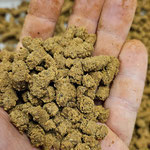
Pellet Production
To produce pellets:
-
the same liquid phase is used without eggs
-
the mix is left deliberately granular
-
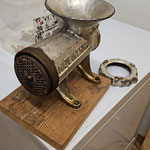
it is passed through a mincer and broken into irregular fragments
A short steaming time of 1–3 minutes:
-
activates starches
-
improves mechanical resistance
-
results in a dissolution time of approximately 20 minutes
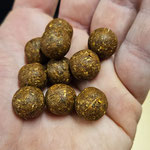
Ball Pellets
Ball pellets follow a different process:
-
1–2 medium eggs per kilogram of mix
-
liquid phase adjusted to maintain machine flow
This results in:
-
dissolution times of 1–3 hours depending on water temperature
-
excellent throwing resistance
Steaming time is reduced to approximately 6 minutes at 18 mm diameter.
For optimal shape retention, ball pellets should be steamed the day after rolling.
Technical Insight Box – Chemical Load Management
When producing pellets and ball pellets, the chemical load should be reduced by approximately 50% compared to
boilies.
This prevents oversaturation, improves signal clarity, and keeps production costs under control.
Final Consideration
The effectiveness of this system does not come from individual ingredients, but from project coherence.
By maintaining the same base matrix across different bait formats:
-
the feeding signal remains consistent
-
carp confidence increases
-
transition between feed and hookbait is seamless
In competitive fishing, this consistency is often the decisive factor.
The difference is not the bait.
It is the project behind it.
Discover the science behind carp bait design. Get the book here.
📷 Gallery Reference
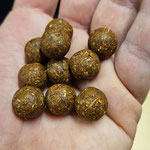
For those who prefer evidence over theory, the final gallery documents the entire process:
raw ingredients, base mix, finished boilies, pellets, and ball pellets.
The images show texture, structure, and consistency across formats, confirming that this system is not a conceptual exercise, but a fully tested and repeatable bait project.