
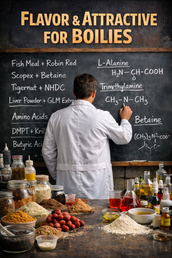
FLAVOUR AND ATTRACTIVE SYNERGIES IN BOILIES: FINDING THE RIGHT BALANCE
Between creating a powerful synergy… and simply throwing together a chaotic mix of ingredients, the line is extremely thin.
In boilie formulation, it takes very little to move from a well-designed combination of attractors to a confusing mixture where everything overlaps, masks itself, and ultimately fails to communicate a credible feeding signal to the carp.
Amino acids, amines, extracts, spices, hydrolysates, flavourings…
it is not the quantity that makes the difference.
What really matters is how these elements interact with each other.
Some ingredients enhance one another.
Others cancel each other out.
Others still create chemical signals that carp immediately recognize as food.
A truly effective boilie is not created by randomly adding ingredients.
It is created when every component has a precise role within the formulation.
The real challenge in boilie formulation
In boilie formulation the problem is rarely which ingredients to use.
The real challenge is how those ingredients interact at a chemical and sensory level.
Free amino acids, amines, hydrolysed proteins, marine extracts, spices, sweeteners and flavour compounds all release specific chemical signals into the water. When these elements are combined without a coherent logic, the result is often a bait where:
-
signals overlap and interfere with each other
-
certain attractors mask others
-
the flavour profile becomes inconsistent
-
chemical dispersion becomes less effective
The result is a boilie that contains many ingredients, yet produces a chemically confusing signal.
When stimuli are structured coherently, however, something very different happens:
-
amino acids enhance the perception of nutritional value
-
certain amines stimulate exploratory feeding behaviour
-
water-soluble extracts create a chemical trail in the water
-
aromatic compounds complete the sensory profile
This is not a matter of quantity.
It is the chemical architecture of the bait.
Carp respond to molecular signals, not ingredient lists
One of the most common mistakes in bait formulation is the belief that attractiveness increases proportionally with the number of ingredients included in the recipe.
In reality, the opposite often occurs.
The more components are added without a clear strategy, the greater the risk of producing a confusing chemical signal where different stimuli overlap, neutralize each other or lose effectiveness.
From a biological and chemical perspective, carp do not respond to a “list of ingredients”. They respond to recognizable molecular signals.
The olfactory and gustatory systems of cyprinids are extremely sensitive to specific classes of compounds, particularly:
-
free amino acids
-
biogenic amines
-
nucleotides
-
small peptides
In carp, these receptors are distributed not only inside the mouth but also on the lips, barbels and skin, allowing the fish to detect chemical cues at extremely low concentrations in the surrounding water.
For this reason, when designing an effective bait it is often far more productive to work with two or three well-chosen stimuli that reinforce each other, rather than accumulating a long list of additives.
In biochemistry this phenomenon is known as synergy: the biological response produced by two molecules together can be significantly stronger than the sum of their individual effects.
Separating two key aspects of bait formulation
Another fundamental concept is the distinction between two different layers of bait design:
1. The flavour profile of the dry mix (solid phase)
Determined by flours, proteins, extracts and nutritional ingredients.
2. The chemical attraction generated by the liquid phase
Responsible for releasing rapidly detectable signals into the water.
These two layers are not necessarily identical.
A boilie may have a flavour profile built within the dry mix, while the liquid phase can be designed to generate an initial chemical signal that operates independently.
Understanding this distinction is one of the key differences between empirical bait mixing and technically structured bait formulation.
Attractive synergies in the liquid phase
The primary objective of the liquid phase is to produce a rapidly detectable chemical signal in the water. Certain combinations of compounds are particularly effective because they reinforce each other at the sensory and biochemical level.
1. Betaine + free amino acids
Betaine is one of the most widely studied feeding stimulants in cyprinids and is commonly used in aquaculture feeds.
When combined with free amino acids such as alanine, glycine, proline or lysine, its effectiveness increases significantly because the mixture mimics the chemical profile of degraded biological tissues and natural food sources.
2. Protein hydrolysates + nucleotides
Protein hydrolysates contain highly soluble peptides and amino acids.
When nucleotides such as inosine monophosphate (IMP) or guanosine monophosphate (GMP) are present, the perception of nutritional signals increases dramatically because this combination resembles the biochemical signature of damaged animal cells.
3. Volatile amines + weak organic acids
Amines such as trimethylamine are highly detectable by carp.
When combined with small amounts of organic acids such as butyric or lactic acid, the resulting chemical profile resembles natural fermentation processes often associated with nutrient-rich food sources.
4. Crustacean extracts + natural nucleotides
Krill, shrimp and other crustacean extracts naturally contain free amino acids and nucleotides.
When this base is reinforced with additional nucleotides or yeast extracts, the resulting synergy amplifies the chemical signal associated with aquatic invertebrate prey.
5. Soluble sugars + betaine
Small amounts of simple sugars or molasses can improve both dispersion and gustatory perception of betaine.
This type of combination often resembles the chemical profile of fermented plant material and microbial activity in natural aquatic environments.
Flavour synergies in the solid phase (the dry mix)
Within the dry mix, synergy primarily concerns the construction of a coherent and credible flavour profile.
Flours and extracts do not simply provide nutrition. They generate recognizable chemical patterns often linked to compounds naturally present in aquatic food sources.
Below are several examples of particularly interesting flavour synergies.
1. Fishmeal + marine algae
Fishmeals naturally contain free amino acids such as glycine, alanine and glutamate, as well as peptides produced during protein breakdown.
Marine algae (kelp, spirulina, chlorella and similar species) are particularly rich in glutamate and natural nucleotides, both strongly associated with umami taste.
This combination produces a powerful synergy:
-
glutamate from algae intensifies the savoury perception of fish proteins
-
nucleotides enhance the umami response triggered by glutamate
-
the mineral composition of algae improves the nutritional balance of the mix
The result is a deep, marine flavour profile closely resembling natural aquatic food sources.
2. Krill meal + liver extract
The synergy between krill and liver is based on the interaction between lipids, peptides and nucleotides.
Krill meal is rich in:
-
highly digestible phospholipids
-
natural nucleotides
-
free amino acids
-
marine aromatic compounds derived from crustaceans
Liver extract provides:
-
highly soluble peptides
-
B-group vitamins
-
nucleotides and nitrogen compounds
-
an intense savoury flavour
Together they create a very rich flavour profile because:
-
liver peptides amplify the protein perception of krill
-
nucleotides from both ingredients reinforce the umami signal
-
krill phospholipids help distribute aromatic compounds within the mix
The result is a complex yet highly coherent signal associated with nutrient-dense animal food sources.
3. Fishmeal + Green Lipped Mussel (GLM)
Green Lipped Mussel powder is one of the most interesting ingredients for building marine flavour profiles.
It naturally contains:
-
free amino acids
-
nucleotides
-
glycoproteins
-
aromatic compounds derived from mollusc tissues
When combined with high-quality fishmeal:
-
GLM nucleotides enhance the umami response of fish proteins
-
mollusc peptides introduce flavour notes distinct from fish sources
-
the resulting profile resembles environments rich in aquatic invertebrates
This combination produces an extremely natural and recognizable flavour signal.
4. Oil-rich seeds (peanut, almond, hazelnut) + inactive yeast
Oilseed meals such as peanut, almond or hazelnut provide:
-
unsaturated fatty acids
-
toasted aromatic compounds
-
mild sweet and nutty notes
Inactive yeast introduces a completely different set of compounds:
-
natural nucleotides
-
glutamate
-
peptides derived from yeast cell walls
-
B vitamins
The synergy occurs because:
-
glutamate intensifies the flavour perception of the oilseed base
-
nucleotides amplify umami-related taste signals
-
lipid notes from the seeds create a softer and more persistent flavour
The resulting profile is rich, slightly sweet and nutritionally dense, with subtle fermentation notes that increase sensory complexity.
5. Robin Red (or carotenoid-rich spices) + fishmeal or crustacean meals
Spices used in products such as Robin Red contain numerous carotenoids, terpenes and phenolic compounds.
Among the most relevant are:
-
capsanthin and capsorubin (paprika carotenoids)
-
carotenes and xanthophylls
-
aromatic compounds derived from spice oils
From an organic chemistry perspective, these molecules possess highly conjugated and lipophilic structures that interact strongly with the lipid fraction of fish or crustacean meals.
These interactions generate several effects:
-
lipophilic carotenoids disperse within the lipid matrix of animal meals
-
spice aromatic compounds are stabilized by natural oils in fishmeal
-
terpenes and phenols introduce warm and persistent aromatic notes
The result is a very distinctive flavour profile where marine protein bases are enriched with complex spicy notes.
Liquid ingredients that modify the final taste of the boilie
The liquid phase is often associated exclusively with immediate attraction in the water. However, many liquid ingredients also modify the final flavour profile of the bait itself.
During mixing and cooking, numerous molecules from the liquid phase penetrate the matrix of the bait, influencing or amplifying the taste generated by the dry ingredients.
Common examples include:
-
essential oils
-
intense sweeteners (NHDC, thaumatin, talin)
-
glutamate
-
salt (sodium chloride)
-
organic acids (lactic, butyric, malic, citric)
-
glycerol or propylene glycol used as flavour carriers
These compounds can act as flavour modulators or sensory enhancers, especially when used in coherent combinations.
Examples of flavour modulation synergies in liquids
1. Salt + glutamate
This is one of the best-known interactions in flavour chemistry.
Glutamate is responsible for umami perception, while sodium ions enhance the sensitivity of taste receptors to this stimulus.
When combined:
-
sodium amplifies glutamate perception
-
glutamate enhances savoury protein flavours in the mix
-
the overall taste becomes fuller and more rounded
2. Glutamate + natural nucleotides
Glutamate shows a very strong synergy with nucleotides such as IMP or GMP.
When both are present:
-
nucleotides dramatically increase umami perception
-
glutamate strengthens receptor activation
-
the resulting flavour intensity is far greater than the sum of each component alone
This phenomenon is widely documented in food chemistry and explains the taste intensity of many fermented or protein-rich foods.
3. Essential oils + organic acids
Essential oils consist largely of terpenes and lipophilic aromatic molecules. These compounds often have powerful aromas but can become unbalanced when used alone.
Adding small amounts of organic acids can create a more balanced sensory profile:
-
acids introduce sharper and more defined taste notes
-
slight pH reduction stabilizes certain aromatic molecules
-
the interaction between acidity and terpene compounds increases flavour complexity
4. Glycerol + essential oils + sweetener
Glycerol is often used as a flavour carrier because it can dissolve and stabilize many aromatic compounds.
When combined with essential oils and sweeteners:
-
glycerol helps distribute aromatic molecules evenly
-
sweeteners soften bitter or harsh notes from essential oils
-
essential oils provide the primary aromatic signal
The result is a more stable and harmonious flavour profile.
Final considerations: a practical guideline to avoid chaotic recipes
If there is one general rule in boilie formulation, it is this:
complexity is not the same as effectiveness.
Many bait mixes become less effective precisely when too many strong ingredients are combined without a clear structure.
Each ingredient introduces aromatic molecules, amino acids, lipids, sugars or nitrogen compounds that contribute to the feeding signal. When too many stimuli are present simultaneously, the resulting signal may become chemically confusing.
For this reason it is useful to follow a few simple guidelines.
1. Limit strong flavour ingredients in the dry mix
Within the solid mix it is generally advisable to use no more than two or three strongly characterized ingredients, such as:
-
crustacean meals
-
Green Lipped Mussel powder
-
liver extracts
-
marine algae
-
inactive yeast
-
strong spice blends
A well-designed mix usually contains:
-
a primary nutritional base
-
one or two defining flavour ingredients
-
optionally a third complementary component
The objective is not artificial complexity, but a clear and recognizable flavour profile.
2. Keep the liquid food structure simple
In the liquid phase it is often effective to work with no more than two main liquid foods, chosen from three general categories:
Protein-based liquids
Examples include:
-
protein hydrolysates
-
corn steep liquor (CSL)
-
fish extracts
-
liquid liver extracts
These ingredients supply peptides, amino acids and nitrogen compounds.
Sugary or fermented liquids
Examples include:
-
molasses
-
sugar syrups
-
fermentation extracts
These provide simple sugars, organic acids and fermentation metabolites.
Lipid-based liquids
Examples include:
-
fish oils
-
crustacean oils
-
selected vegetable oils
These contribute lipids and lipophilic aromatic compounds.
The most coherent combinations are generally:
-
protein + sugary
-
protein + lipid
-
sugary + lipid
Using more than two liquid foods often leads to chemical redundancy and loss of clarity in the signal.
3. Build the attractor system around 2–3 key elements
Besides liquid foods, many recipes include small quantities of attractors or taste modulators.
Even here, it is best to limit the formulation to two or three carefully selected elements, such as:
-
amino acids + glutamate
-
betaine + free amino acids
-
sweetener + salt
-
essential oil + organic acid
-
flavour compound + essential oil
Too many attractors can easily produce a disorganized chemical signal.
Think of a boilie as a feeding signal
An effective boilie is not simply a recipe.
It is a coordinated chemical signal.
The dry mix provides the nutritional and flavour base.
The liquid phase generates the initial dispersion of signals in water.
The attractors refine the sensory perception of the bait.
When these three layers work coherently together, the bait becomes:
-
recognizable
-
nutritionally credible
-
repeatedly accepted by carp
In other words, a good boilie is not a complex formula.
It is a clear chemical message.
And when that message is coherent, carp recognize it immediately as food.
For more technical articles and in-depth discussions about bait formulation and carp attractants, visit the English section of my blog:
Discover the science behind carp bait design. Get the book here.