
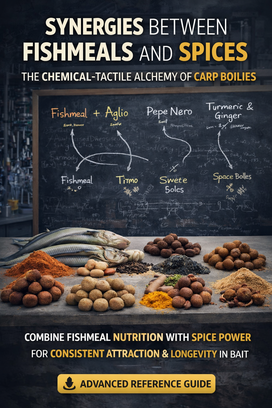
Chemistry, feeding signals and advanced boilie design for experienced bait makers
INTRODUCTION: BEYOND THE CONCEPT OF “FLAVOUR”
In modern carp fishing, one of the most common mistakes is to treat spices as simple flavouring agents and fishmeals as mere protein ingredients.
This view is overly simplistic.
In reality, when these two elements are combined correctly, something far more complex is created:
👉 a multi-layered chemical system capable of modulating carp feeding behaviour
Fishmeals provide the nutritional base and the primary feeding signal.
Spices act as modulators, intensifiers and stabilisers of that signal.
The result is not a “better smelling” boilie.
It is a boilie that is more biologically interpretable for the fish and more palatable.
Taste is a key factor in pushing carp to continue feeding once they have sampled the bait.
THE FUNDAMENTAL PRINCIPLE: CARP READ SIGNALS, NOT INGREDIENTS
Carp do not perceive:
- fishmeal
- paprika
- garlic
They perceive:
- free amino acids
- amines
- nucleotides
- volatile compounds
- complex chemical patterns
Fishmeals generate a primary signal based on:
- degraded proteins
- peptides
- marine lipids
- biogenic amines
Spices introduce:
- terpenes
- phenols
- sulphur compounds
- lipophilic aromatic molecules
- strong and persistent taste
👉 True effectiveness arises when these systems interact, not when they simply coexist.
KEY INTERACTION 1: LIPOPHILIC SPICES + FISHMEAL LIPIDS
Many spice-derived aromatic molecules are lipophilic:
- capsaicinoids (paprika)
- cinnamaldehyde (cinnamon)
- eugenol (clove)
- terpenes (essential oils)
These molecules:
👉 dissolve into the lipid fraction of fishmeals
This generates four key effects:
-
Aromatic stabilisation
→ reduced degradation in water -
Progressive release
→ longer and more consistent leakage - Uniform distribution within the mix
- Strong, persistent taste profile
👉 This is why:
fishmeal + spices performs far better than spices alone
KEY INTERACTION 2: SULPHUR COMPOUNDS + ANIMAL PROTEINS
Spices such as:
- garlic (allicin)
- asafoetida
- onion
contain sulphur-based compounds.
These compounds:
👉 mimic chemical signals associated with:
- protein breakdown
- animal tissue degradation
- natural fermentation
When combined with fishmeal:
✔ they amplify the protein signal
✔ increase recognisability
✔ stimulate exploratory feeding behaviour
👉 This explains why:
garlic + fishmeal remains one of the most effective and widely trusted combinations of all time
KEY INTERACTION 3: SPICES + NUCLEOTIDES AND AMINO ACIDS
Fishmeals (especially LT and hydrolysed types) contain:
- glutamate
- nucleotides
- peptides
Spices do not directly provide these compounds, but:
👉 they modulate taste perception
Examples:
-
piperine (black pepper)
→ enhances perception of other compounds -
terpenes
→ amplify aromatic intensity - red thyme (strong gustatory interaction)
👉 Result:
the same chemical signal is perceived as stronger and more attractive
KEY INTERACTION 4: SPICES AND RELEASE DYNAMICS
Fishmeals operate across different time frames:
- predigested → fast
- LT → slow
Spices, especially in oil-based form:
👉 sit between these phases
Effect:
- bridge fast and slow release
- smooth out signal continuity
- prevent “dead zones” in attraction
THE MOST EFFECTIVE SYNERGIES (TECHNICAL ANALYSIS)
1. FISHMEAL + PAPRIKA
Chemical basis:
- carotenoids + lipids
Effects:
- aromatic stabilisation
- increased persistence
- chemical profile similar to crustacean-based food sources
👉 Best use:
- classic fishmixes
- krill-based baits
- long-term baiting campaigns
2. FISHMEAL + GARLIC
Chemical basis:
- sulphur compounds
Effects:
- strong feeding stimulation
- mimicry of protein breakdown
👉 Best use:
- cold water
- long-term baiting
- new spots
3. FISHMEAL + BLACK PEPPER
Chemical basis:
- piperine
Effects:
- enhanced perception
- improved flavour diffusion
👉 Best use:
- technical boilies
- complex mixes
- combined with esters and organic oils
4. FISHMEAL + TURMERIC + GINGER
Chemical basis:
- curcuminoids + gingerols
Effects:
- digestive support
- metabolic modulation
👉 Best use:
- food baits
- long-term feeding strategies
5. FISHMEAL + THYME / RED THYME
Chemical basis:
- thymol
Effects:
- fermentation stabilisation
- complex biological signalling
- outstanding taste profile
👉 Best use:
- liver-based mixes
- nutrient-rich environments
6. FISHMEAL + SWEET SPICES (CINNAMON + NUTMEG)
Effects:
- flavour balance
- increased acceptance
👉 Best use:
- nut-based combinations
- pressured waters
ADVANCED STRATEGY: DESIGNING A MULTI-LAYERED BOILIE
A modern boilie should integrate:
Phase 1 (instant)
- predigested fishmeal
- volatile spices
Phase 2 (mid-term)
- lipophilic spices
- medium fishmeals
Phase 3 (long-term)
- LT fishmeal
- lipid components
👉 Spices act as the bridge between phases
CRITICAL MISTAKES TO AVOID
❌ Random use of spices
❌ Overdosing
❌ Weak nutritional base
❌ Overcomplicated mixes
❌ Ignoring fishmeal quality
FINAL PRINCIPLE: SIGNAL COHERENCE
An effective boilie is not the richest one.
It is the one that communicates:
✔ clearly
✔ consistently
✔ over time
Spices should not mask.
They should build the language of the bait.
CONCLUSION: CHEMISTRY, NOT MAGIC
The synergy between fishmeals and spices is not random.
It is the result of:
- organic chemistry
- fish physiology
- release dynamics
- field experience
The pioneers understood this intuitively.
Today, we can explain it.
A note on evolution: essential oils vs powdered spices
Modern bait design is increasingly moving towards the use of essential oils rather than powdered spices within the mix.
This offers several advantages:
- superior cost-to-effect ratio
- easier and more precise dosing
- absence of unwanted off-flavours
- better distribution of active compounds within the bait
SCIENTIFIC REFERENCES
- NRC (2011) – Nutrient Requirements of Fish
- Hardy, R.W. (2010) – Utilization of Fish Meal
- Glencross, B.D. (2020) – Fish Nutrition Review
- Chowdhury et al. (2021) – Turmeric and Ginger in Fish
- Hassan et al. (2024) – Phytogenic Feed Additives
- Georgieva et al. (2019) – Plant Extracts in Aquaculture
CARP FISHING REFERENCES
- Rod Hutchinson – The Carp Strikes Back
- Kevin Maddocks – Carp Fever
- Fred Wilton – High Nutritional Value Theory
- Sergio Tomasella – Boilie: istruzioni per l’uso
📘 Boilies,the Art and Science of Carp Bait
A great boilie is never the result of luck.
In my book dedicated to boilie formulation you will find:
- the real chemistry behind attractants
- the exact role of each ingredient
- advanced formulation strategies
- dozens of tested mixes
👉 If you really want to understand what you are doing when you design a bait…
Download the full book here: