
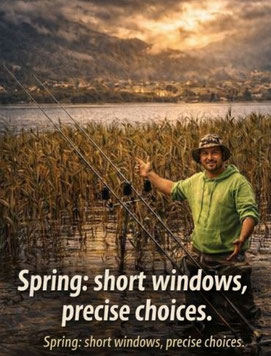
Spring doesn’t forgive improvisation
There is one season when many carp anglers restart — but very few do it the right way.
Spring is full of promise, but it is also the most unstable and misleading period of the entire year.
The problem is simple: your calendar does not match the water’s calendar.
You may have sunshine, 12–14°C air temperature and the feeling that the season has started, while underwater the system is still slow, stratified and biologically unstable.
And when the water is unstable, carp are unstable too. They move, warm up, then shut down again. They don’t feed consistently — they feed in windows.
From a biological standpoint, this is perfectly logical.
Carp (Cyprinus carpio) are ectothermic animals, meaning their metabolism is directly controlled by water temperature. A key concept here is the Q10 coefficient: metabolic rate roughly doubles with every 10°C increase.
However, metabolism and feeding are not perfectly aligned.
Digestive efficiency depends on enzyme activity, which increases with temperature, while gut transit time becomes faster. At the same time, feeding behaviour is hormonally regulated and linked to energy balance, not just external conditions.
Research on carp physiology shows that feeding-related pathways respond strongly to fasting and refeeding cycles, confirming that feeding is a controlled and selective process — not a simple reaction to warmer water.
This is why spring is not about “more activity”, but about intermittent and strategic feeding.
To succeed, you need to:
- read the water, not the air
- choose spots based on phase, not aesthetics
- use baits that stimulate and nourish efficiently
February: the strangest month of the year
February has always been unpredictable. Today more than ever.
In the past, it was often a dead month — freezing temperatures, low activity, random captures. It was mainly used to prepare: organizing gear and producing baits for the pre-spawn phase, often based on high nutritional value (HNV) concepts.
Today, conditions can shift quickly. Mild days and stable weather windows can still make winter spots productive.
But February can also completely break your game.
In recent years, heavy weather events — rain, snow and floods — often arrive later in the season. This creates two major issues, especially in rivers.
The first is turbidity.
Carp rely heavily on chemical detection to locate food. Amino acids and other soluble compounds act as primary feeding triggers, and carp can detect them at extremely low concentrations.
However, when water is loaded with suspended particles, this system becomes less efficient.
Fish follow chemical gradients in the water. When turbidity increases, these gradients are disrupted. The signal is still present, but less structured and harder to interpret.
This leads to a very specific behaviour:
carp may still feed, but with reduced efficiency and in shorter, less predictable windows.
The second issue is environmental reset.
Floods don’t just disturb fish — they reshape the entire bottom. Sediments move, feeding zones change, and prebaited areas can be completely neutralized. What worked before may no longer exist.
Then there is snowmelt, one of the most underestimated factors.
Meltwater entering rivers and lakes can drop temperatures to 3–4°C, causing metabolic slowdown and near shutdown of feeding activity.
In these conditions, trying to refine your approach is often pointless. The only logical move is to change it.
The false spring
A common and dangerous scenario is early warming.
Shallow waters, canals, small lakes and slightly coloured environments warm up quickly. This triggers early benthic activity and can create short feeding phases as carp begin recovering from winter.
At the same time, hormonal processes linked to spawning begin to develop, usually becoming significant above 15°C.
The real problem is instability.
Temperature swings — warm periods followed by sudden cold returns — create physiological stress. Immune systems weaken, metabolic rhythms are disrupted, and feeding becomes inconsistent.
For the angler, this translates into a familiar pattern: strong signals one day, complete silence the next.
Fishing the windows: low impact, high precision
In early spring, you should think in terms of opportunities, not seasons.
Warm, stable days create feeding windows. These windows are short, fragile and extremely valuable.
The correct approach is minimalist:
- one rod, two at most
- maximum stealth
- extremely localised baiting
Small PVA bags or sticks with crushed boilies and micro pellets are ideal. Liquid liver or similar highly soluble attractors can enhance the signal.
At this stage, profiles such as liver and bloodworm are particularly effective because they trigger feeding even when metabolic activity is still limited.
Sun exposure and micro-environments
Water does not react to temperature like air does.
Changes appear first in:
- shallow areas
- darker substrates
- sheltered zones protected from cold wind
When you have several stable days above 12°C, these micro-environments become key.
Approach them with simplicity:
- small, precise presentations
- minimal disturbance
- total confidence
In early spring, success is not measured in numbers. Sometimes, just getting a bite is already a meaningful result.
Above 12°C: a biological shift
After a few days of stable warming, something changes.
Larger carp begin to shift from opportunistic behaviour to selective feeding.
Scientific observations show that fish are capable of associating food with post-ingestive benefits. Feeding behaviour is influenced not only by attraction, but also by nutritional feedback.
Certain amino acids actively stimulate feeding responses, while others play a neutral or even inhibitory role.
This is the real foundation of HNV bait theory.
High-quality bait is not just more nutritious.
It is more recognizable, more biologically relevant, and more reliable over time.
But one rule remains absolute:
Bait does not find fish.
Bait converts presence into feeding.
Spots and environments
Small lakes and pits are ideal environments in spring. They are easier to read and allow you to manage multiple spots from a single swim. A simple prebaiting strategy across a few key areas is often enough.
Canals offer natural holding zones such as bends, reed beds and pumping stations, especially as spawning approaches.
Rivers can be exceptional under the right conditions: clear water, stable flow and absence of snowmelt are critical. In these scenarios, confluences, slack waters and connected backwaters can produce outstanding results.
Large lakes and big pits require a different mindset. Here, information is everything. Seasonal movements and spawning areas are often consistent year after year. Keeping records of captures, conditions and locations creates a long-term advantage.
Baits: modern HNV logic
Modern carp fishing is no longer about quantity. It is about precision.
Instead of large prebaiting campaigns, the modern approach is based on:
- smaller quantities
- better placement
- higher quality
Milk proteins remain one of the most powerful tools available.
They are not only highly digestible, but also biologically active. They break down quickly under bacterial and enzymatic action, releasing amino acids and organic acids into the water.
This creates a dynamic and progressive attraction signal.
From a technical perspective, bait effectiveness depends on solubility and diffusion.
Water-soluble compounds form chemical gradients that carp can detect and follow. Olfactory receptors in fish are extremely sensitive and respond in a dose-dependent way to these signals.
This means:
- higher solubility = faster detection
- better diffusion = wider attraction radius
Example HNV mix (high protein – balanced cost)
A practical modern HNV base mix could look like this:
- 20% defatted soy flour
- 20% poultry meal
- 20% semolina (binder)
- 15% inactive yeast
- 10% whey protein concentrate (WPC 80)
- 10% corn protein (corn gluten)
- 5% egg albumin
This formulation provides approximately 50–51% protein, an extremely high value compared to most natural food sources available to carp.
Functional logic of the mix
Each ingredient has a precise role:
- soy flour → structure and plant protein base
- poultry meal → digestible animal protein
- semolina → binding
- yeast → palatability and stimulation
- WPC → high biological value and solubility
- corn protein → density and balance
- albumin → hardness and stability
This is not just a high-protein bait.
It is a functional system, designed to:
- release signals efficiently
- remain stable on the bottom
- provide real nutritional value
Enhancing the mix: pH and biological stimulation
A highly effective modern approach is to work on acidity and microbiology.
For example:
- paprika
- apple cider vinegar
For 10 kg of mix:
- 1 litre apple cider vinegar
- 1 kg paprika
This creates:
- a slightly acidic environment
- enhanced microbial activity
- a signal similar to natural food sources such as invertebrates and decomposing organic matter
The result is a bait that works progressively over time, without relying on aggressive artificial attractors.
Spring bait strategy
In spring, less is more — but only if it is done correctly.
These baits are designed for:
- light prebaiting (1–2 kg)
- precise placement
- maximum efficiency
In practice:
- small stringers
- crushed boilie PVA bags
- minimal but accurate feeding
This is the modern evolution of HNV:
less quantity, more intelligence.
Final perspective
From a biological point of view, spring carp fishing is governed by three key factors:
- temperature stability
- chemical detectability
- nutritional relevance
Success is not based on strong flavours or random attraction.
It is based on coherence.
The right place, at the right time, with the right presentation and the right bait.
Everything else is noise.
A final note
If this approach resonates with you, it’s because you’ve probably understood one thing:
there is no shortcut in carp fishing.
Bait is not just something you throw in the water.
It is a language. A system. A strategy.
And once you start understanding how that system really works — biologically, chemically and practically — everything changes.
That is exactly the reason why I wrote Boilies, The Art and Science of Carp Bait.
Inside the book you won’t find generic recipes or recycled ideas.
You will find a complete framework:
- how to build baits based on real nutritional logic
- how to adapt recipes to different waters and seasons
- how to control solubility, attraction and digestion
- how to create baits that keep working over time
From simple, cost-effective mixes to highly specialized formulations, every recipe is designed to solve a specific problem you face on the bank.
Because in the end, the difference is not the bait itself.
It’s understanding why it works — and when it works.