Ion exchange between boilie and water: what really happens
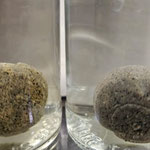
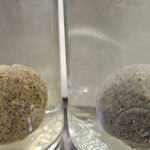
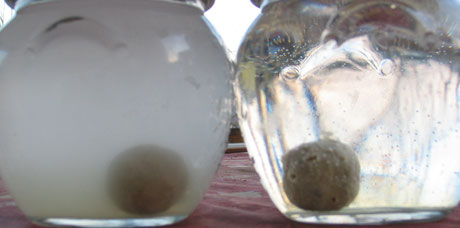
Look closely at the photo.
Two containers, two different waters, same boilie.
After a few hours one is clearly more “loaded” than the other. It’s not a visual impression, it’s an actual difference in the exchange between bait and water.
In the water with higher pH it worked more, faster, and you can see it without needing instruments. At the time I also measured it with a conductivity meter and the data was consistent: conductivity increased more rapidly, a sign that the boilie was releasing more substances into solution.
This is the starting point, because inside such a simple test there is a concept that, if properly understood, completely changes the way of thinking about baits.
We are not talking about “release” in a generic sense.
We are talking about an exchange.
When a boilie enters the water it doesn’t simply lose something. It comes into equilibrium with the environment.
The boilie is a complex system: proteins, free amino acids, salts, organic acids, sugars, flavors, hydrolyzed fractions. The water is another system, with its own composition, its own pH, its own ionic charge.
At the moment the two systems come into contact, a gradient is created and everything starts from there.
Substances move not because they “have to come out”, but because they seek a chemical balance between inside and outside. This movement is regulated by concentration, electrical charge, solubility, and pH.
And this is where most discussions about baits become superficial.
In the test I carried out (hundreds of tests, using accurate measurement instruments, conductivity meter and also mass spectrography), alkaline water extracted more in the same time. This is correct, and perfectly explainable.
Many of the attractors we use in boilies have an acidic character or behave as such in solution: organic acids, aromatic components, liquid liver fractions, free amino acids.
In an alkaline environment these molecules tend to dissociate more, that is, to ionize. When a molecule is ionized, it interacts much better with water and its solubility increases. As a result it moves more easily, diffuses faster, and is extracted more quickly.
In an acidic environment the opposite happens for many of these substances: dissociation is reduced, solubility may decrease, and exchange slows down.
Said like this it seems like a simplification, but the basic concept is this and it must be reasoned in relation to fishing, not strictly in a scientific sense.
Speaking about amino acids, the main attractants studied by science for pet food, if we want to be more rigorous, we must enter the discussion of the isoelectric point.
Each amino acid has its own isoelectric point, that is, a pH value at which the overall charge of the molecule is zero. In that condition the molecule is less mobile, tends to interact less with the solvent, and its solubility may decrease.
When the pH of the water moves away from that value, the amino acid takes on a net positive or negative charge. At that point its interaction with water increases, as does its ability to go into solution and to diffuse.
This means that the same boilie, in the same spot, can have completely different behaviors simply because the pH of the water changes.
When the boilie releases substances, it doesn’t release only neutral molecules but also ions. The more ions are present in solution, the greater the water’s ability to conduct electricity. Therefore an increase in conductivity is a direct indicator of the intensity of the exchange.
It’s not an advanced laboratory instrument, but for this type of evaluation it is more than sufficient and above all it gives an objective confirmation of what you see.
At this point we need to take a step further, because not all waters behave the same way.
Clear water, low in minerals, with low conductivity, has few dissolved ions. The gradient between boilie and water is high, therefore the exchange is rapid. If in addition the pH is alkaline, the extraction of acidic substances is even faster.
Turbid water, rich in organic matter, is a completely different environment. There are already many suspended particles, many colloids, often a higher ionic charge. Some molecules are absorbed, others bind, the gradient decreases and the exchange becomes less effective. In many cases the pH also tends toward lower values, and this further contributes to slowing the release of some components.
Brackish water is yet another world. Here the concentration of ions is high, and this creates phenomena of competition and shielding. Some molecules struggle more to diffuse, others change behavior, others may precipitate or bind to ions present in the water. The exchange does not stop, but it completely changes dynamics.
All of this, brought back to fishing, has a very simple meaning.
There is no absolutely correct dosage of attractors.
There is a correct dosage for that water, and each attractor must be chosen and selected carefully if I want to create the perfect bait for a specific environment. I am obviously talking about fast attraction, because feeding the fish (pre-baiting) is another matter.
In clean and alkaline water, where exchange is fast, it makes sense to stay lower with liquids, because extraction will still be rapid. In fact, pushing too much can lead to a release that is too violent in the first minutes and to early exhaustion.
In turbid or slightly acidic water, where exchange is slower, it makes sense to increase dosages, precisely to compensate for the lower mobility of the molecules and ensure sufficient chemical presence around the bait.
It is an adaptation, not a fixed rule.
There is then one last aspect worth remembering.
The most evident difference in exchange occurs in the first hours. That is when the system is far from equilibrium and the movement of substances is more pronounced. Over time everything tends to stabilize.
After several hours, when most of the more soluble substances have already come out, other processes come into play. The boilie begins to degrade, the bacteria on the bottom work, proteins break down and new attractive molecules are generated.
At that point it is no longer just dissolution chemistry, but transformation.
And that is another chapter, of particular interest for those who pre-bait.
Those who pre-bait continuously, those who build an area and maintain it over time, are much less interested in the speed of exchange in the first hours.
In that type of approach, the initial peak matters little. What really makes the difference is what happens afterwards.
After three, four hours of immersion, the boilie begins to change nature. The more soluble components have already been released, the system approaches an equilibrium and at that point a completely different process comes into play: transformation.
It is no longer just diffusion, but degradation.
The bacteria present on the bottom begin to work on the components of the mix, and here a topic opens that many underestimate. Not all bases react in the same way.
A mix rich in protein flours, particularly of animal origin or in any case of high biological value, provides a completely different substrate compared to a mix based mainly on starches.
The degradation of proteins leads to the release of low molecular weight peptides, free amino acids and nitrogen compounds that have a direct impact on the feeding stimulation of carp.
It is an “internal” organic chemistry, which develops over time and can become extremely powerful as an attractant.
On the contrary, the degradation of starches follows different pathways, mainly leading to simpler sugars and fermentative products which, although having their role, hardly reach the same level of feeding stimulation as degraded protein fractions.
This means that, in a continuous pre-baiting strategy, it makes much more sense to work on the quality and type of flours in the mix rather than pushing the liquid part to obtain a fast release.
Because in that context you are not trying to “call” the fish in the short term, but to build over time a feeding area that is credible, consistent and recognizable.
And this difference, once again, is all there: understanding when speed is needed and when depth is needed instead.
What you see in this photo, therefore, is not a curious effect from an improvised laboratory.
It is a practical demonstration of a simple principle: the bait does not work on its own, it works in relation to the water you put it in.
Understanding this relationship means stopping reasoning in absolute terms and starting to build baits and strategies in a way that is consistent with the environment.
The rest, as always, follows.
Do you like this type of content? Do you want to understand the why behind things and learn about bait chemistry and how they work in water?
Boilies,the Art and Science of Carp Bait is the right book for you!
Download it from the website at this link: Boilies,the Art and Science of Carp Bait
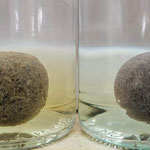
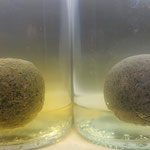
The photos in the gallery below represent another test, from a different point of view. In this case, the same water is used—pure, at pH 8 and 20°C—and the boilies immersed are two “HNV Gustosa.” The one on the right was rolled using only mix + egg. The one on the left includes its liquid component.
This comparison is meant to show how an HNV boilie, which is technically quite closed and slow to start working, can be accelerated by hyper-hydrating it with an effective liquid component. It’s a way to demonstrate to those who believe that the mix alone is the key factor that, in reality, attraction is largely driven by the liquids used in the recipe and their concentration.
It is interesting to observe how, in the first 4–5 hours, attraction is significant only in the bait with the dedicated liquid component (the “HNV Gustosa” are in fact HNV boilies made faster to start working thanks to a careful study of attractive liquids), while as the hours pass, the attractive component of the HNV mix also begins to emerge. As I have explained many times, this happens because the mix gradually degrades over time, breaking down its protein flours through the action of naturally present bacteria. This process releases a large amount of water-soluble substances that are highly attractive to fish—true natural feeding triggers.
It is therefore easy to understand how the liquid component is essential for anglers who fish without pre-baiting and for those doing short sessions (in these cases, in addition to the liquid component, it is also advisable to produce partially soluble baits).
Special thanks to Stefano and Massimo for the photos.