
Milk Derivatives in Boilies: The Science Behind Milk Proteins, Attraction and Bait Structure

Nutritional value, mechanical function, and the real differences between ingredients
In the world of boilie design, few ingredient families have shaped the evolution of modern carp bait as profoundly as milk derivatives.
They were among the first “high-grade” ingredients introduced into carp fishing baits, and they remain—still today—one of the most complex, misunderstood, and often misused categories in bait formulation.
Most anglers know that “milk proteins work.”
Very few truly understand why.
And even fewer realize that under the generic label of milk derivatives lies a wide spectrum of ingredients with radically different:
- nutritional roles
- sensory profiles
- mechanical functions
- technological behaviors
Treating them as interchangeable is one of the most common mistakes in bait making.
This article has a clear objective:
to bring order and clarity—while giving you a practical framework to understand how these ingredients really behave inside a boilie.
Why Milk Changed Boilie History
From a biological standpoint, milk is a complete nutritional system. It supports early growth in mammals and contains a refined combination of:
- proteins
- sugars
- lipids
- minerals
- bioactive compounds
But when milk derivatives entered boilie formulation, the real revolution was not only nutritional.
It was structural.
Milk proteins are unique in bait making because they don’t just feed—they build.
They actively contribute to:
- internal matrix formation
- micro-porosity
- liquid retention
- structural cohesion
- controlled release of attractors
This leads to a crucial concept:
👉 Milk derivatives are not just protein sources. They are architectural ingredients.
A well-designed boilie is not a compact mass of flours.
It is a micro-structured system made of pores, bonds, emulsions, and internal pathways.
Milk proteins—when properly balanced—are among the few ingredients capable of significantly improving this internal architecture.
Not All Milk Derivatives Do the Same Job
One of the most common mistakes in bait formulation is substituting one milk ingredient for another assuming they are equivalent.
They are not.
- Whole milk powder ≠ skimmed milk powder
- Casein ≠ caseinate
- Whey powder ≠ whey protein concentrate
- Hydrolysates ≠ intact proteins
Each ingredient has a specific function:
- some enhance nutrition
- some improve palatability
- some control structure
- some regulate emulsions and liquid phases
Understanding this distinction is what separates a recipe mixer from a true bait designer.
Key Milk Ingredients (Simplified Functional Overview)
To keep this article focused, here is a streamlined functional view of the main categories:
Whole Milk Powder
Balanced, creamy, and harmonizing.
Improves palatability and rounds off aggressive mixes.
Skimmed Milk Powder
A technical regulator.
Improves structure and consistency without adding excess fat.
Whey Powder
Cost-effective and light.
Supports porosity and diffusion but has limited structural strength.
Whey Protein Concentrate (WPC)
A key modern ingredient.
Balances digestibility, structure, and controlled release.
Whey Hydrolysates
Pre-digested and fast acting.
Ideal for instant attraction and high-reaction scenarios.
Casein (Acid / Rennet)
The structural backbone.
Creates strong, stable, long-lasting bait matrices.
Caseinates
Protein emulsifiers.
Essential in complex mixes rich in oils and liquids.
Cream Powders & Sweet Dairy Derivatives
Primarily sensory tools.
Enhance attractiveness, not structural performance.
Fermented Milk (Yogurt, Kefir)
Chemically dynamic.
Introduce acidity and fermentation-related signals.
The Hidden Dimension: Mechanical Control
The least understood—but most important—aspect of milk derivatives is their mechanical influence.
A well-selected milk protein can:
- improve emulsification of fats
- stabilize high-liquid mixes
- create micro-porosity
- regulate hardness and breakdown
- control drying behavior
- influence water exchange
- extend or shorten bait life
This is why the bait industry relies heavily on milk derivatives—not just for nutrition, but for system control.
The Most Overlooked Factor: What Happens on the Lakebed
Boilies Don’t Just Release… They Transform
Stopping the analysis at “attraction” is a major limitation.
Because once a boilie reaches the lakebed, a second process begins:
👉 biological transformation
The lakebed is not passive. It is a biologically active environment rich in:
- heterotrophic bacteria
- extracellular enzymes
- microbial biofilms
- natural fermentative systems
When a boilie settles, it doesn’t just hydrate.
It undergoes selective degradation.
Milk Proteins: The Ideal Substrate
Milk proteins (caseins and whey proteins) share a critical property:
👉 they are highly susceptible to bacterial proteases
This leads to a progressive breakdown:
- proteins → peptides
- peptides → free amino acids
- amino acids → amines, organic acids, volatile compounds
And this is where things become extremely interesting.
The Birth of a Natural Feeding Signal
The compounds generated through bacterial degradation are:
- highly soluble
- easily detected by carp chemoreceptors
- chemically similar to natural food decomposition signals
These include:
- free amino acids (glycine, alanine, leucine…)
- low molecular weight peptides
- trace ammonia
- biogenic amines
- organic acids
👉 This combination represents one of the most powerful feeding triggers in aquatic environments.
This is not artificial flavor.
This is evolutionarily recognized chemistry.
Different Milk Ingredients, Different Behaviour on the Bottom
Each milk derivative influences this process differently:
- Caseins → slow degradation, long-term signal
- WPC → balanced release and transformation
- Hydrolysates → immediate but short-lived response
- Fermented derivatives → accelerate bacterial activity
- Milk powders → support but do not dominate the process
The Key Concept That Changes Everything
👉 A boilie is not just what it releases.
👉 It is what it becomes over time on the lakebed.
Milk derivatives are among the few ingredients capable of:
- initiating attraction
- sustaining biological transformation
- generating new signals over time
In other words:
👉 they are not just attractors
👉 they are precursors of attractors
Practical Implication for Bait Design
This leads to a fundamental shift in thinking:
- For instant attraction → use hydrolysates
- For long-term performance → use caseins
- For balance → use WPC or skimmed milk
- For cost efficiency → use whey or feed-grade milk
But most importantly:
👉 you must design a bait based on how it evolves—not just how it starts.
Final Insight
The true strength of milk derivatives is not limited to:
- nutritional value
- palatability
- mechanical performance
Their real power lies in acting as a biological interface between:
- the bait
- the water
- the lakebed
- microbial life
- and the carp’s sensory system
This is where modern bait design moves from mixing ingredients…
to engineering dynamic systems.
Want to Go Deeper?
This article only scratches the surface of what milk derivatives can really do inside a boilie.
In the full book, I break down:
- advanced formulation strategies
- precise inclusion levels
- real-world bait design models
- industrial vs homemade approaches
- and the full science behind biological bait evolution
👉 Boilies,the Art and Science of Carp Bait
If you want to truly understand how to design boilies—not just make them—this is where the real work begins.
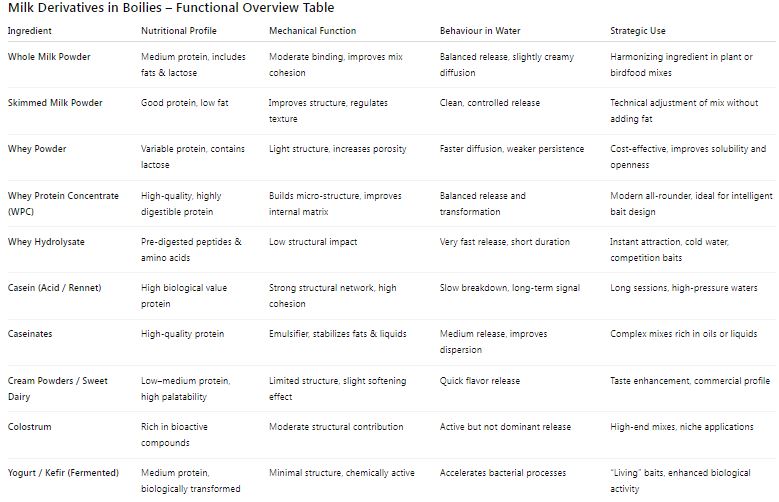
Key Takeaway
👉 The real power of milk derivatives lies in how they combine:
- Caseins build the structure
- WPC balances release and digestibility
- Hydrolysates trigger immediate attraction
- Fermented ingredients accelerate biological activity
A great boilie is not about one ingredient.
It’s about how these elements interact over time.