
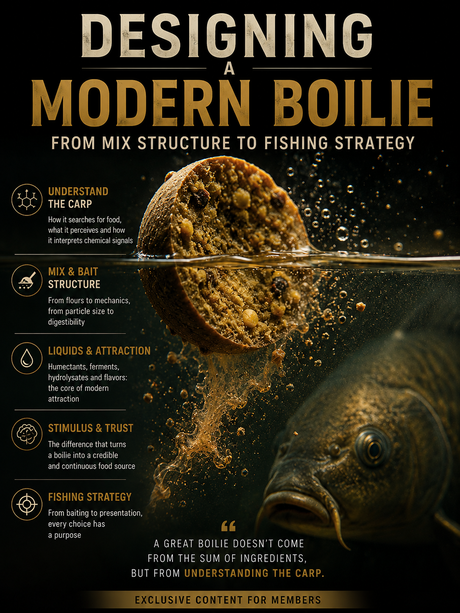
# Designing a Modern Boilie
## From Mix Structure to Fishing Strategy
For many carp anglers, self-made bait still simply means mixing ingredients together. They look for “powerful” components, strongly scented meals, pungent attractors, convinced that a superior boilie comes from combining unusual or exotic ingredients. In reality, the path to building a truly effective bait begins long before the mix itself. It starts with understanding the carp, the way it feeds, what it naturally searches for, and how it perceives chemical signals in the water.
Over the years, self-made bait has changed dramatically. The first boilies were built almost entirely around the nutritional concept: super food baits designed for long-term baiting campaigns, often rich in high-quality proteins and expensive ingredients. Today, however, many anglers focus on short sessions, mobile fishing, pressured venues, and waters where the speed of bait response matters more than its long-term nutritional value. This has inevitably changed the way boilies are designed.
A modern boilie must be consistent with the context in which it will be used, and this is where many anglers make their first mistake: there is no universally “best” mix, only the right mix for a specific fishing situation.
The carp is an extremely evolved omnivore, capable of adapting to very different food sources. In nature it feeds on larvae, molluscs, crustaceans, insects, seeds, plant matter, organic detritus, and virtually any nutritional source it can intercept. But what matters most to us is how it searches for food. Many anglers imagine carp relying mainly on smell, as happens with other animals, while in reality its sensory system is far more complex and involves a network of chemical receptors distributed not only in the mouth, but also on the barbels, lips, and across the body surface. Carp are constantly “tasting” the water.
Free amino acids, soluble peptides, certain organic acids, and many substances produced by food degradation or fermentation represent extremely important biological signals because they indicate the possible presence of digestible and nutritionally useful food. This is where the modern concept of attraction comes from. For years, everything was oversimplified into generic ideas of “smell” or “fragrance,” but an effective boilie does not work because it smells good — it works because it releases chemical signals that the fish interprets as food.
This also explains why ingredients that seem unpleasant to the human nose can be devastatingly effective in fishing. Predigested fish proteins, liver extracts, fermented sauces, belachan, or various hydrolysates often smell aggressive and unpleasant to us, but they are loaded with instantly recognisable feeding signals for carp. Understanding this changes the entire way a mix is designed.
The first question should never be “which flours or meals should I use?”, but rather: “What kind of response do I want from the fish?”
A long baiting campaign requires a completely different approach compared to a short reaction session. In the first case, we can work on food confidence and gradual conditioning. In the second, we need an ultra-fast bait capable of exchanging signals quickly in the water and triggering an immediate response.
This is where the distinction between nutritional baits and attractive baits is born.
The former, historically identified with HNV mixes, classic fishmeals, liver mixes, or rich nut-based baits, are designed to become a recognised food source. They must be digestible, balanced, economically sustainable in large quantities, and nutritionally complete enough to support prolonged baiting campaigns. In these projects, the real nutritional value of the bait plays a major role, and ingredients such as LT fishmeal, caseins, milk proteins, liver products, yeasts, and animal derivatives become central.
On the other side, we find all those baits built primarily to stimulate a rapid response — the classic trigger baits. This category perfectly includes 50/50 mixes, many birdfood mixes, lighter nut-based mixes, yeast mixes, and all those structures focused mainly on taste, diffusion, and exchange speed. These are often cheaper baits, nutritionally less demanding, but extremely effective for short sessions or situations where the fish must make a quick decision.
The most interesting part, however, lies somewhere in the middle, because many of the most effective modern boilies are actually hybrids. Birdfood bases cut with fishmeal, vegetable mixes reinforced with yeasts, nut mixes corrected with animal derivatives or technical fishmeals and predigested proteins — combinations capable of maintaining high attraction speed without completely sacrificing the food bait concept.
---
# Stimulus and Confidence: The Two Phases That Define a Boilie’s Value
A modern boilie should not simply attract carp.
It must convince them to keep feeding without suspicion.
This apparently simple statement contains one of the biggest differences between a bait designed merely to “make noise” and one truly built to catch fish.
Stimulus is the first spark. It is what leads the fish to detect the bait, approach it, become interested, and interact with what we have placed on the lakebed. It may come from an aromatic signal, a cloud of soluble substances, an active liquid food, a fermented ingredient, a salty component, or a particularly pronounced taste profile.
But stimulus alone is not enough. In some situations, it can even become a limitation. A bait that is too obvious or too recognisable may work extremely well initially, especially on lightly pressured fish or during competitive feeding situations, but it can also create suspicion once repeatedly associated with danger. Carp learn. They do not reason like humans, but they associate experiences, signals, and consequences. If a particular flavour profile, taste, or chemical signature repeatedly precedes a hook, that signal may gradually lose effectiveness.
Confidence is something entirely different.
Confidence develops when the bait goes beyond initial curiosity and becomes accepted as a credible food source. It is no longer just something attractive, but something the fish can ingest, digest, and encounter again without negative consequences. This is where nutritional quality, digestibility, flavour consistency, bait mechanics, bait quantity, fishing pressure, and time all come into play.
A “hit-and-run” bait works mainly on stimulus, while a food bait works mainly on confidence. The best modern baits, however, often seek a balance between these two worlds: they must call the fish in, but also hold them; they must be quick, but not suspicious; recognisable, but not so artificial that they become warning signals.
This is why a good boilie should never be designed solely around how hard it “pulls” in the first few minutes. You also need to ask what happens afterwards. What happens when the fish sucks it in, crushes it, ejects it, picks it up again, digests it, or encounters it again over the following days? It is within this sequence of micro-experiences that confidence is either built or destroyed.
A boilie rich in soluble signals may instantly trigger interest, but if its structure is inconsistent, if the flavour is excessively artificial, if digestion is heavy, or if the bait is always used the same way in heavily pressured waters, that same initial strength can become negative recognition.
Conversely, a less flashy but more balanced boilie may appear slower — at least to our eyes — but over time it can build a far deeper feeding relationship with the fish.
This is where the bait maker must choose with clarity.
If I am facing a short session without prebaiting, perhaps on a spot where fish are only passing through and I have no time to condition them, then stimulus becomes the priority. I will therefore use more open mixes, stronger liquid packages, soluble ingredients, fermented elements, carefully dosed flavours, humectants, and anything capable of making the bait communicate quickly.
If, on the other hand, I want to build a baiting campaign, or I regularly fish the same area, then confidence becomes central. In that case the bait should be less extreme and more food-oriented, less aggressive and more consistent — capable of being eaten repeatedly without saturating, overloading, or alarming the fish.
Once again, the most interesting point lies in the middle.
The smartest modern boilie is often the one that stimulates without screaming and builds confidence without becoming slow. A well-structured birdfood base, a sensible inclusion of fishmeal or yeast, a properly balanced soluble fraction, a clear but non-caricatured flavour profile, and a coherent liquid package can create a bait capable of working immediately while also being accepted as food.
This is probably one of the most mature steps in modern bait design: stopping the question “how attractive is it?” and starting to ask “what kind of relationship does it build with the fish?”
Because captures are often born from stimulus, but consistency is born from confidence.
---
Let’s consider, for example, a very simple conceptual mix like this:
* 70% classic birdfood mix
* 15% LT fishmeal or meat meal
* 10% characteristic nutritional ingredient such as yeast extract, predigested fishmeal, or peanut meal
* 5% extract such as fruit powder, belachan, GLM, or any palatant
A blend like this perfectly represents the concept of the modern hybrid boilie. The birdfood structure guarantees texture, digestibility, signal exchange, and ease of rolling, while the fishmeal or meat component builds a credible food base. The predigested ingredient dramatically accelerates the release of chemical signals and stimulates feeding, while the extract creates a strong, lasting, recognisable taste profile. It is not an extreme nutritional boilie, but neither is it just an empty instant-action bait. It is a bait designed to both catch fish and feed them.
And this is where the liquid package comes into play — probably the most evolved aspect of modern bait design today.
Many carp anglers still focus almost exclusively on the dry mix, while in reality a huge part of a boilie’s attraction speed comes from the liquids. Water-soluble ingredients, hydrolysates, fermented sauces, amino extracts, flavours, essential oils, and even acidifiers profoundly change the way the bait works underwater.
A possible liquid package evolution for the mix above could look like this:
* 100 ml of a hydrating, attractive, flavour-rich liquid (CSL, soy sauce, fermented fish sauce, or any liquid food like those discussed in this blog section)
* 50 ml of propylene glycol or vegetable glycerine to keep the bait hydrated
* A medium dose of a flavour you trust
* A characterful essential oil (black pepper, asafoetida, red thyme, garlic, clove, etc.)
Naturally, all of this must fit coherently within the bait’s overall concept. Heavy hydration makes sense mainly in fast-action boilies, where rapid signal exchange is a concrete advantage, while in long-term food baits a drier and more stable bait may actually be preferable.
A liquid package like this works on several levels simultaneously. The predigested liquid and fermented sauce massively increase the release of amino acids and soluble feeding signals, the glycol keeps the bait moist and reactive, while the flavour and essential oil build a far more complex attraction layering than most anglers realise.
And this layering of signals is one of the most fascinating aspects of modern boilie design. A good bait does not communicate just one piece of information to the fish. It communicates taste, nutrients, fermentation, solubility, energy, and recognisability through different release timings.
For example, flavours often work primarily during the earliest stages, depending on the solvent and water pH, while heavier and more persistent ingredients — such as essential oils or certain spice meals — create a secondary taste profile that lasts much longer.
Even the concept of hyper-hydration comes from the need to accelerate chemical exchange. A fresh, moist boilie rich in liquids starts working immediately, while a fully dried bait first needs to rehydrate. This does not mean a dry boilie is worse; it simply means it works on different timings. And this very characteristic makes it excellent for long-term baiting campaigns, where remaining effective on the lakebed for hours is an advantage.
Modern instant-action baits, on the other hand, often focus on immediate reactivity. This is why we see stronger use of liquid foods, humectants, glycol, glycerine, fermented sauces, and hydrolysed extracts capable of dramatically increasing chemical exchange during the first minutes of immersion.
The role of flavours also deserves a far more serious discussion than what is usually found in mainstream bait marketing. For years, marketing promoted the idea that a boilie’s success depended mainly on its “smell,” but carp do not interpret banana or strawberry flavours the way humans do. What matters to them is the overall chemical signal — and above all, the context.
A lightly pressured fish may respond extremely well to a strong flavour signal. A carp constantly exposed to angling pressure, however, may quickly learn to associate certain overly recognisable signals with danger. Carp associative memory is far more developed than many anglers believe, and this is one reason why the best long-term baits are rarely the flashiest ones. They are the most coherent.
Coherent in structure, taste, release profile, exchange speed, and in the balance between nutrition and attraction.
---
# GLYCOL AND GLYCERINE: THE DIFFERENCES
Among the most commonly used humectants in modern boilies, monopropylene glycol and glycerine are undoubtedly the two main choices. Both help keep the bait moist, elastic, and reactive over time, but they work differently and behave very differently depending on water temperature.
Monopropylene glycol (E1520) is probably the more technical and versatile solution. It has a strong hygroscopic capacity, meaning it retains moisture and prevents the bait from drying too quickly, but above all it remains highly stable even at low temperatures. This aspect is crucial because in cold water it maintains good fluidity and does not excessively slow down the bait’s osmotic exchange.
For this reason, glycol is the ideal choice:
* in winter,
* in cold waters,
* in deep gravel pits and large lakes,
* in winter rivers,
* or whenever a very fast and reactive bait is required.
It also has excellent preservative properties and helps diffuse flavours and water-soluble components. Mechanically, it keeps the boilie moist while remaining relatively stable and compact.
Glycerine (E422), on the other hand, works in a softer way. It also retains water and keeps baits fresh, but tends to create a sweeter, softer, and more elastic texture. In warm or temperate water it can be extremely interesting because it helps produce very soft, lively boilies with excellent exchange in the outer layers of the bait.
Its limitations appear in cold water. Glycerine becomes more viscous as temperatures drop and tends to slow the bait down more significantly. It can also slightly harden the outer layer when water temperatures become very low.
For this reason, glycerine works best:
* in late spring,
* summer,
* early autumn,
* in warm waters,
* in highly attractive fast-action mixes,
* or in soft boilies designed for quick sessions and throwing stick applications.
From a flavour perspective, glycerine also has a slight sweetness that integrates perfectly with birdfood mixes, nut mixes, cream mixes, and sweeter spicy profiles.
Glycol, on the other hand, remains more neutral and “technical,” adapting better to fishmeal mixes, liver mixes, fermented baits, or projects heavily focused on proteins and amino-based attraction.
At this point, it becomes obvious that designing a modern boilie means thinking on multiple levels simultaneously. It is not enough to know the ingredients — you must understand what they do in the water, how they interact with one another, how the fish perceive them, and above all, what fishing strategy they are meant to support.
A boilie designed for a gravel pit rich in natural food and wary big carp will be profoundly different from one intended for a low-stock canal fished quickly under heavy competitive feeding conditions.
And this is exactly the most fascinating part of self-made bait. Not the search for the ultimate recipe, but the possibility of building a bait perfectly coherent with your own vision of fishing.
Many of the concepts discussed in this article come from the work developed over the years within my book dedicated to boilie design and modern self-made bait, where these topics are explored in much greater depth through technical explanations, complete recipes, and detailed studies of ingredients and bait construction.
Boilies,the Art and Science of Carp Bait
At the same time, understanding how to create a great boilie is only one part of the equation. Because even the best bait in the world loses much of its potential if it is not used in the right place, at the correct time, and within a coherent strategy. This is why I have always considered it essential to study not only bait design, but also environments and carp behaviour — because understanding where to look for fish, how they move, and how they read the water remains, even today, the real key to turning a good boilie into a memorable capture.