
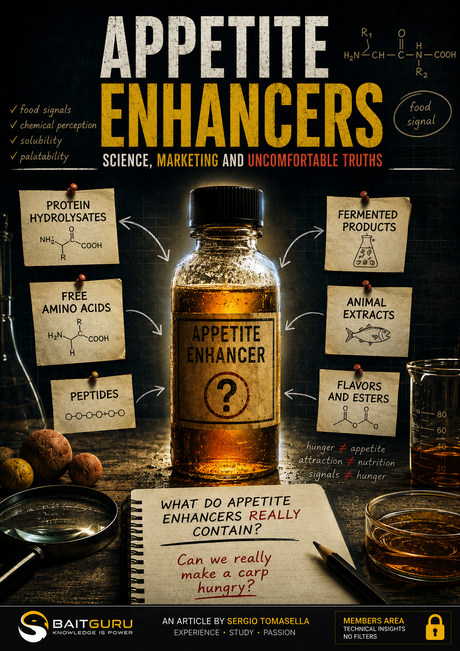
Carp Appetite Stimulants: Science, Marketing and Uncomfortable Truths
Behind appetite enhancers, feeding triggers and miraculous attractors lies a question that almost no angler ever asks: is it really possible to make a carp hungry?
"If someone had truly discovered a way to make a fully satiated carp hungry, they wouldn’t have invented a new attractor. They would have revolutionised animal physiology."
THE MYTH OF THE APPETITE STIMULATOR
Even the name itself is brilliant. It sounds like one of those terms created specifically to make us picture a lethargic carp sitting motionless on the bottom, perhaps with a full belly and absolutely no desire to move, that suddenly intercepts our hookbait and is overwhelmed by an irresistible chemical hunger that causes it to abandon every resistance and inhibition.
A kind of biological potion that you pour over your bait, add to your liquid food, mix into your method mix, or spray onto a PVA bag and from that moment on the carp stops thinking and simply has to eat. Not because it needs nourishment, not because our approach is correct, not because we have managed to build an interesting feeding area, but because there is something inside that little bottle that switches hunger on.
Unfortunately, biology tends to work in a slightly more complicated way.
And this is where the first major misunderstanding begins.
In the commercial language of carp fishing, terms such as appetite stimulant, appetite enhancer, feeding trigger and all the rest are often used as if they identified a precise, recognised and measurable technical category. In reality, in most cases, they are pure marketing. Effective words, without question. Words that sell well. But not necessarily words that explain well.
Because making a bait more interesting, more recognisable, more appealing or more readily accepted by a carp is one thing.
Making it hungry is something completely different.
Hunger cannot simply be switched on at will. It is not a magical reaction that we can control from the outside with a few millilitres of a dark, fragrant liquid. Hunger is a complex physiological condition linked to the animal’s energy status, temperature, metabolism, environment, natural food availability, season and a thousand other factors that cannot be dismissed with an aggressive slogan printed on a label.
This does not mean certain products are useless.
Far from it. Some can be extremely interesting components in the construction of a bait or a baiting strategy. The point is different: we need to call things by their proper names.
If an ingredient increases palatability, let’s say it increases palatability. If it improves the flavour profile, let’s say it improves flavour. If it contains soluble substances that can be detected by a carp, let’s say exactly that.
But if we claim it creates hunger, then we are stepping into very delicate territory where catalogue stories are no longer enough.
We need definitions, mechanisms, dosages and evidence.
And above all we need a simple question, almost a trivial one, but devastating in its implications:
Can a satiated carp be made hungry by a product added to a bait?
Everything starts from this question.
THE FIRST UNCOMFORTABLE QUESTION: WHAT IS HUNGER?
Before we can understand whether we are capable of stimulating a carp’s appetite, perhaps we should stop for a moment and ask what hunger actually is. It sounds like a simple question, but this is exactly where it makes sense to begin.
When we hear people talking about appetite stimulants, we naturally imagine hunger as something very straightforward: the carp does not feel like feeding, we add a miraculous product to the bait, and suddenly it decides to eat. Unfortunately for those selling easy solutions, biology is a little more complicated than that.
Hunger is not a switch that can be turned on and off at will. It is one of the most important survival mechanisms found in nature. An animal must constantly evaluate how much energy it has available, how much it is consuming, the risks involved in searching for food and the benefits that feeding may provide.
A carp performs exactly the same type of assessment, although obviously not consciously in the way a human would. Instead, it does so through a series of physiological mechanisms that have evolved over millions of years.
Water temperature, metabolism, physical activity, natural food availability, the quantity of food already consumed and even the animal’s overall condition all contribute to determining its willingness to feed.
Think, for example, of a carp in the middle of winter. As temperatures fall, metabolism slows down, energy requirements decrease and consequently interest in food declines. This is not a decision. It is a perfectly logical physiological response.
But we do not even need to use winter as an example. Any angler with a minimum amount of experience knows perfectly well that genuine feeding windows exist. Periods during which carp seem active, move around, feed and respond well to bait, alternating with others where their feeding activity drops dramatically.
If an appetite stimulant were enough to solve the problem, then we should be able to catch fish with the same ease at any time of day and under any conditions. We all know that is not the case.
This does not mean, however, that an inactive carp is completely uninterested in what surrounds it. A fish may not be in a genuine feeding phase and still react to an unusual stimulus, an interesting chemical signal or a food item capable of provoking curiosity.
And this is often where the misunderstanding begins.
Many times we attribute a behaviour to hunger when in reality it may simply be explained by curiosity, exploratory instinct or a bait’s ability to stand out from everything around it.
At this point it is worth asking a very simple question.
Can we really believe that a few millilitres of flavour, extract or additive poured onto a boilie are capable of completely overriding all of these mechanisms?
Personally, I have serious doubts.
This does not mean that a carp with little inclination to feed cannot be attracted by a bait, intrigued by a chemical signal or encouraged to sample a particularly interesting food source. It simply means we are talking about phenomena that are different from hunger.
And here we arrive at the heart of the issue.
In carp fishing, and more generally in bait marketing, terms such as hunger, appetite, attraction, acceptance and palatability are often mixed together as if they meant the same thing. In reality they describe very different processes, and understanding this distinction is essential if we want to understand what many of the products we use in our baits actually do.
HUNGER, APPETITE AND PALATABILITY ARE NOT THE SAME THING
At this point it is necessary to bring some order into the discussion, because much of the confusion originates from the fact that we use different words as if they were synonyms.
Hunger is a physiological necessity. It is the response of an organism when it requires energy and nutrients. In other words, it is the reason why an animal seeks food.
Appetite is something different. We can define it as the predisposition to feed or the desire to consume a particular food. It is a more nuanced concept and can be influenced by numerous external factors.
Then there is palatability, a term widely used in animal nutrition and one that can simply be described as the pleasantness or acceptability of a food. In practice it measures how much an animal appreciates a food once it comes into contact with it.
To understand the difference, all we have to do is think about ourselves.
It can happen that we finish a large dinner and feel completely full. In theory, we should have no interest whatsoever in any more food. Then someone places our favourite dessert on the table and suddenly we find room for another slice. Has hunger returned?
Of course not.
We are simply faced with a food that we find particularly appealing.
Something very similar happens in the world of bait.
When we use ingredients rich in soluble compounds, animal extracts, fermented products, protein hydrolysates or other raw materials that are particularly interesting to carp, we are not necessarily creating hunger. Much more often, we are increasing the attractiveness and palatability of the food. In other words, we are making that bait easier to locate, more interesting to investigate and more enjoyable to consume.
It may seem like a purely theoretical distinction, but in reality it completely changes the way we interpret many products currently available on the market.
Because if a manufacturer claims that an ingredient increases palatability, improves flavour profile or promotes bait acceptance, they are describing something that is perfectly plausible.
If, on the other hand, they claim that the product is capable of switching on hunger regardless of the animal’s physiological condition, then they should be able to explain very clearly the mechanism through which that result is achieved.
And this is precisely where explanations almost always begin to become vague.
Very vague...
WHAT DO APPETITE STIMULANTS REALLY CONTAIN (OR WHAT SHOULD THEY CONTAIN)?
At this point comes the question every angler should ask when picking up a bottle of appetite enhancer or appetite stimulant:
What is actually inside?
The question is far more important than it may appear, because marketing often encourages us to focus on the promised effect rather than the actual composition of the product.
Which is understandable.
After all, if a label promises more captures, more feeding responses and increased feeding activity, my attention immediately shifts to the final result and much less to what is supposed to produce that result.
And yet that is exactly where the answer lies.
In most cases, behind imaginative names and more or less mysterious descriptions, we find ingredients that the animal nutrition industry has been using for decades:
- Protein hydrolysates.
- Liver extracts.
- Yeasts.
- Fish extracts.
- Fermented products.
- Amino acids.
- Sugars.
- Organic acids.
- Betaine.
- Blood derivatives.
Nothing magical.
And above all, nothing unknown.
Quite the opposite.
Many of these ingredients are extremely interesting and still represent some of the most effective raw materials available to us when formulating bait.
The problem begins when properties are attributed to them that they probably do not possess.
Take a protein hydrolysate as an example.
During the hydrolysis process, proteins are broken down into smaller molecules that are highly soluble and rapidly detectable by the carp’s sensory organs. This means the product can become an excellent feeding signal and contribute to making a bait more recognisable.
But that is still a long way from saying that it creates hunger.
Exactly the same applies to liver extracts, fish derivatives and fermented products. These ingredients are rich in organic compounds capable of dramatically increasing interest in a food source, especially when used within a well-designed formulation.
But interest and hunger remain two very different things.
Betaine itself is probably one of the most interesting examples.
For years it was described as a sort of miracle substance capable of triggering feeding behaviour in carp. In reality, scientific literature identifies it as a molecule naturally present in numerous living organisms and involved in a variety of biological processes.
The fact that it may play an interesting role as a feeding signal does not automatically mean that it is capable of switching on hunger in a satiated animal.
The fundamental point is that almost all of these ingredients have a credible scientific explanation.
They work because they can be recognised as feeding signals.
They work because they increase bait solubility.
They work because they improve taste.
They work because they mimic substances that carp naturally encounter within their normal food sources.
These reasons are already extremely interesting.
There is no need to invent others.
Because when we begin looking closely at the actual composition of many appetite stimulants, we often discover that we are not observing some revolutionary product category.
We are simply looking at food ingredients that have been known for many years, described in a very different way.
Naturally, all of this reasoning assumes that the product actually contains functional ingredients in meaningful quantities.
Because talking about hydrolysates, extracts, amino acids and biologically interesting compounds is fascinating, but the real issue is always the same:
Knowing what is actually inside the bottle.
Unfortunately, transparency regarding formulations is not always a priority within our industry, and very often the angler is forced to rely on the promises printed on the label.
Personally, I always hope that behind certain grandiose product names there are genuinely high-quality raw materials rather than simply a well-packaged mixture of solvents, flavourings, colourants and marketing.
Because in the first case we are discussing nutrition and chemistry applied to bait.
In the second, we are discussing advertising.
WHY THESE PRODUCTS WORK
At this point someone might conclude that appetite enhancers are nothing more than a commercial gimmick and that all these ingredients have no practical value whatsoever.
That would be the wrong conclusion.
The fact that a product cannot switch on hunger in a carp as if it were a biological light switch does not mean that it cannot influence feeding behaviour.
Quite the opposite.
A large proportion of the research conducted in animal nutrition, aquaculture and even industrial feed formulation is based precisely on the ability of certain substances to increase food acceptance and palatability.
To understand the concept, we need to return for a moment to the natural environment in which a carp lives.
Water is an extraordinarily rich medium of chemical information.
Every living organism continuously releases molecules into the surrounding environment, and many of these can be detected by aquatic animals.
A carp does not simply see the world around it.
It also perceives it through a complex network of chemical receptors that allow it to identify potential food sources, recognise danger and gather information essential for survival.
When we introduce a bait rich in soluble compounds and stimuli into the water, we inevitably alter this chemical landscape.
We are not sending a command that tells the fish to eat.
We are constructing a series of signals that can be detected, interpreted and subsequently associated with the presence of a potential food source.
This is exactly why I have always dedicated so much space in my books to the liquid component of bait.
A well-produced hydrolysate is not interesting because it “creates hunger”.
It is interesting because it contains free amino acids, low molecular weight peptides and numerous compounds derived from protein degradation that can disperse rapidly through the water and become easily detectable.
The same applies to many fermented products.
During fermentation, molecules are produced that profoundly alter the chemical profile of the original raw materials, increasing the availability of soluble substances and generating new compounds capable of exerting a strong sensory attraction.
The world of flavours deserves a separate discussion altogether.
Many anglers still tend to think of flavours simply as scents, but flavour chemistry is considerably more complex than it appears.
Certain esters, certain essential oils and numerous natural aromatic molecules possess diffusion and persistence characteristics that can help make a bait more recognisable within the aquatic environment, especially when incorporated into a balanced formulation that is coherent with the rest of the attractor profile.
In essence, the real objective is not to create hunger.
The real objective is to build a credible, intense and easily interpretable chemical trail.
That is an enormous difference.
In the first case we are chasing a form of biological magic.
In the second we are working with principles that are supported by animal physiology and scientific research.
It is no coincidence that certain substances repeatedly appear throughout the aquaculture and fish nutrition literature.
Amino acids such as glycine, alanine and proline have been studied extensively for their role as feeding signals in numerous fish species.
Betaine remains one of the most investigated molecules because of its ability to influence feeding behaviour and feed acceptance.
Numerous nucleotides, peptides derived from protein hydrolysates and compounds produced through microbial fermentation are routinely used to improve the palatability of feeds intended for intensive aquaculture production.
Naturally, this does not mean that a bottle containing one of these ingredients automatically becomes an extraordinary product.
It does mean, however, that there is a substantial difference between a formulation built around substances whose biological behaviour we understand and a formulation that simply invokes mysterious appetite stimulants without explaining what it actually contains.
And it is precisely within that difference that the boundary between marketing and bait technology exists.
THE SUBSTANCES THAT REALLY DESERVE ATTENTION
After discussing marketing, appetite, hunger and feeding signals, I think it is time to address the question that truly matters to those who formulate bait.
Which substances actually deserve our attention?
The answer may surprise many anglers, because most of the most interesting compounds are not secret industrial ingredients hidden away in some mysterious laboratory.
Quite the opposite.
They are molecules that have been known for decades, studied within nutritional science, used extensively in aquaculture and naturally present in the foods fish encounter every day.
The first major category consists of free amino acids.
When a protein begins to break down naturally, or undergoes hydrolysis, amino acids are released and rapidly become available within the aquatic environment.
For many years we have known that various fish species are capable of detecting extremely low concentrations of these substances and that certain amino acids exert a particularly interesting influence on feeding behaviour.
The reason is not difficult to understand.
In nature, amino acids represent a sort of biological signature associated with animal tissues, living organisms, decomposing organic matter and, more generally, potential food sources.
When a carp intercepts this type of signal, it is not receiving an order to feed.
It is receiving information.
The second category that deserves attention is peptides.
For many years anglers focused almost exclusively on amino acids, whereas today we know that much of the effectiveness of a good hydrolysate probably derives from the simultaneous presence of both amino acids and small protein fragments.
Peptides are among the principal intermediate products of protein digestion and enzymatic degradation, and they represent an extremely credible feeding signal for numerous aquatic organisms.
This is why a quality hydrolysate is often far more interesting than a simple blend of artificially added amino acids.
The third category is probably one of the most underestimated by anglers:
Fermented products.
When we observe fermentation, we often focus on the smells generated during the process.
In reality, the most interesting part is what happens at the biochemical level.
Microorganisms break down complex molecules into simpler substances, increase nutrient availability, produce organic acids, aromatic compounds, peptides, enzymes and numerous other molecules that profoundly alter the chemical profile of the original raw material.
In other words, fermentation does not simply add attraction.
It transforms the food.
And that is probably why so many fermented products continue to produce interesting results both in animal nutrition and in modern carp fishing.
Then we come to a substance that has become almost legendary within carp fishing:
Betaine.
Almost everything imaginable has been written about betaine, often with considerable exaggeration in both positive and negative directions.
As so often happens, the truth lies somewhere in the middle.
Betaine is a natural molecule found in a vast number of living organisms and performs well-documented biological functions.
Several studies have highlighted its ability to influence feeding behaviour in certain fish species, which is why it continues to be used in numerous commercial formulations.
Is it an interesting substance?
Without any doubt.
Finally, there is a world that is often ignored by those who think exclusively in nutritional terms:
Volatile aromatic compounds.
Here we need to be careful because we are entering territory that is very different from amino acids or hydrolysates.
A flavour does not provide nutrients and, in most cases, does not represent a natural feeding signal.
Nevertheless, it can contribute to making a bait more recognisable, more distinctive and easier to distinguish from the chemical background noise of the surrounding environment.
Think about fruit esters, numerous molecules present in essential oils or aromatic compounds that food chemistry has used for decades to define specific sensory profiles.
Many anglers make the mistake of taking extreme positions.
On one side are those who believe flavours are everything.
On the other are those who insist they are completely useless.
As is often the case, reality is more complex and usually lies somewhere in between.
A flavour is unlikely to transform a poor bait into a good bait.
But when incorporated into a formulation that is already solid from both a nutritional and attractor perspective, it can help create a more recognisable and coherent chemical identity.
And perhaps that is the most interesting conclusion of all.
After decades of advertising, slogans and miracle products, most of the substances that continue to demonstrate a credible biological logic belong to very simple categories:
Amino acids.
Peptides.
Fermentation products.
Natural extracts.
Compounds derived from protein degradation.
And a number of carefully selected aromatic molecules.
No magic.
No secret formulas.
No hunger switches.
THE QUESTIONS WE SHOULD START ASKING OURSELVES
At this point, I believe the most interesting question is no longer whether appetite stimulants exist.
The real question is another one:
What are we actually trying to achieve when we formulate a bait?
If our objective is to create a food source that a carp can locate, recognise and consume with confidence, then we already have numerous practical tools at our disposal.
We can work on protein quality, free amino acid content, hydrolysis processes, fermentation, flavour systems, ingredient solubility and, more generally, on the bait’s ability to communicate with its environment through credible chemical signals.
If, on the other hand, we continue searching for a substance capable of switching hunger on at will, we are probably pursuing something that belongs more to marketing than to animal physiology.
This line of reasoning inevitably leads to another reflection that I have seen emerging more and more frequently within the bait world over recent years.
Many anglers spend weeks searching for the perfect boilie and then believe they can completely transform it during the final thirty seconds by dipping it into a brightly coloured gel, a particularly thick booster or some attractor with a promising name.
Don’t misunderstand me.
The liquid component is enormously important.
Anyone who has read my books knows how much space I have dedicated to hydrolysates, fermented products, extracts and even flavour chemistry.
For years I have argued that a substantial part of the effectiveness of a modern bait depends precisely on its ability to release chemical signals into the water.
But for exactly that reason I have always considered the liquid component a design element rather than a last-minute dip.
A good attractor can enhance a good bait.
It can increase the speed of response.
It can enrich the chemical profile.
It can help make the bait more recognisable.
What it is unlikely to do is single-handedly correct a weak formulation.
Because ultimately a carp does not interact only with the bait’s surface.
It interacts with its contents.
With its nutritional value.
With the quality of the signals it continues to receive over time.
And above all with the experience that food creates after it has been consumed.
This is a concept that is often underestimated.
We focus intensely on the first minute and far too little on the hours, the days and sometimes even the years required to build the feeding reputation of a bait.
Perhaps this is the greatest uncomfortable truth of all.
In modern carp fishing we constantly talk about attraction and far too little about food.
We constantly talk about triggers and far too little about nutrition.
We constantly talk about bottles and far too little about formulation.
And yet the history of the baits that have genuinely left their mark on carp fishing almost always tells the same story.
Not the story of a product capable of making fish hungry.
But the story of baits built around credible feeding signals, quality ingredients and formulations that have earned the trust of carp over time.
Perhaps the next time we read the words “appetite stimulant” we should simply stop for a moment and ask a few more questions.
Which substance is supposed to produce this effect?
How is it supposed to work?
What evidence supports it?
And above all:
What is actually inside that bottle?
Because very often the quality of the answers we obtain depends on the quality of the questions we are willing to ask.
For those who would like to explore these subjects in greater depth, understand the role of liquid attractors, hydrolysates, fermentation, flavours and, more generally, the mechanisms that make a bait genuinely effective, I recommend reading my book Boilies,the Art and Science of Carp Bait
Within the book I have devoted considerable space not only to ingredients and formulations, but above all to the principles that underpin the construction of a modern bait.
The objective is not to provide miracle recipes or shortcuts, but to help the reader understand why certain substances work, what the limitations of many common commercial claims are, and how to develop a more informed approach to designing their own baits.
Because in the long term, the real difference is not made by mysterious products or sensational promises.
It is made by knowledge.
And knowledge, fortunately, is the only attractor that continues to work in every season.