
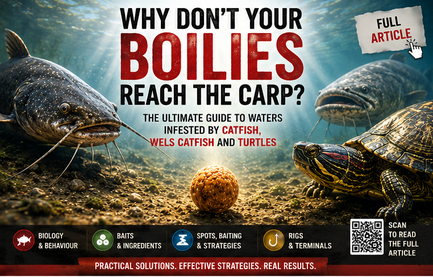
Carp Fishing with Catfish, Wels Catfish and Turtles: Strategies, Baits and Solutions to Keep Catching Carp
"Is there really a boilie that catfish do not like? Is it possible to fish effectively in waters overrun by turtles and Wels catfish? In this in-depth article we will analyse behaviour, feeding habits, fishing strategies and specialist baits to continue targeting big carp even in the most difficult environments."
THE PROBLEM OF INVASIVE SPECIES
Over the last few decades carp fishing has undergone a profound transformation. Tackle has changed, baits have changed, anglers have become far more technically prepared and, above all, the environments in which we practice our passion have changed.
Many waters that we once considered relatively simple to interpret have progressively become more complex, not necessarily because there are fewer carp, but because new disturbance factors have been added that heavily influence our fishing.
Among these, one of the most important is undoubtedly the spread of invasive species or, at the very least, species that are extremely problematic for the carp angler.
In gravel pits, ponds and small lakes it is now common to encounter the American pond slider (Trachemys scripta), a reptile introduced by man that has found ideal conditions in which to proliferate. It is an opportunistic, voracious animal, perfectly adapted to aquatic life and capable of preying upon eggs, larvae, fry and a huge variety of organisms present in the environment. From the carp angler's point of view the problem is even more concrete, because these turtles rapidly develop an almost obsessive interest in our hookbaits, often completely compromising the presentation.
In large rivers, canals and slow-flowing waters the main culprit is the Channel Catfish (Ictalurus punctatus), a species that in many areas has reached astonishing densities. Anyone who fishes the River Po or other large European waterways knows the situation well: baited areas cleaned out within hours, rigs constantly disturbed and sessions transformed into an endless sequence of unwanted bites.
Completing the picture is the European Wels catfish, a very different fish from the American catfish but one that, in certain situations, can further increase the complexity of the environment, influencing carp behaviour and modifying feeding dynamics.
The problem is that all these species share one characteristic that directly affects us as anglers: they are extremely efficient at locating food.
There is however an important difference worth highlighting immediately. The American catfish and the American turtle are generally direct consumers of our baits, whereas the Wels catfish often represents a more indirect problem linked to the environmental changes created by large baiting campaigns. While catfish and turtles interact directly with boilies, particles and hookbaits, Wels catfish can also be attracted by the increased biological activity that develops around a food-rich area.
When we prepare a highly attractive boilie, introduce a large baiting campaign or create a particularly interesting feeding area, we are not sending a message exclusively to carp. We are communicating with the entire ecosystem and especially with those troublesome opportunists.
Many anglers approach the problem by looking for a magical bait that appeals to carp but not to catfish, turtles or Wels catfish. It is an understandable search, but unfortunately it starts from a flawed assumption.
The real challenge is not to eliminate the disturbance completely, but to reduce it enough to allow carp to feed before the unwanted visitors are able to compromise our strategy.
This does not mean that we are destined to suffer the problem passively, it means that we must understand it.
Because the difference between a session dominated by catfish and a memorable capture often does not depend on a single special bait, but on a collection of small adjustments involving spot selection, baiting strategy, boilie composition, bait size, season and even the way we choose to present the rig.
And that is exactly where we will begin.
After many years spent discussing baits, both on the bank and through books, articles and conversations with other anglers, I have become convinced that there is one question that returns more often than any other whenever the subject of catfish, turtles or Wels catfish arises.
The question is always the same.
"Which boilie do catfish not like?" or "Which flavour keeps turtles away?" or even "Is there a bait that selects carp while avoiding nuisance species?"
They are understandable questions because they arise from frustration, after retrieving a disturbed rig for the tenth time or watching a baited area disappear within a few hours. It is only natural to look for a simple and definitive solution. The problem is that such a solution does not exist, or at least not in the way many anglers imagine.
There are no substances capable of attracting carp while simultaneously repelling catfish, Wels catfish or turtles.
There are no magical flavours, secret ingredients or miraculous combinations capable of creating a selective barrier around our baits.
All these animals live in the same environment, share many food sources and, despite sometimes profound differences, are programmed to search for food using chemical signals dissolved in the water.
When a substance communicates "food", very often it communicates the same information to several species at the same time.
This does not mean that they all react in the same way or with the same intensity. It simply means that the concept of absolute repellence belongs more to carp fishing mythology than to biological reality.
The good news is that we do not need a repellent bait to catch carp. What we need is to understand which signals attract nuisance species the most and which are more favourable to cyprinids.
The difference may seem subtle, but it completely changes the way we approach the problem.
One thing is to search for a bait that repels catfish.
Another is to build a strategy that continues to interest carp while reducing catfish interest to the absolute minimum.
For many years the world of boilies associated effectiveness with the concept of extreme attraction. The more feeding signals a boilie released, the more effective it was considered. In many situations this approach is still correct, but in waters infested by opportunistic species it can quickly become a major problem, and the reason is simple.
The substances we most frequently use to increase the primary attraction of a boilie are often the same substances detected with extraordinary efficiency by catfish, Wels catfish and turtles.
Fish hydrolysates, predigested fishmeals, liver extracts, fermented products, free amino acids, peptides, animal-derived liquids and many other ingredients represent extremely powerful feeding signals.
The problem is that they are not perceived only by carp.
In some cases they are actually even more attractive to nuisance species than they are to our target fish.
One of the greatest evolutions I experienced as a professional bait developer was precisely understanding that attraction and feeding interest are not necessarily the same thing.
A boilie can be extremely attractive, extremely palatable and extremely nutritious, but these three characteristics do not always coincide.
And here we arrive at a very important consideration for the subject we are discussing, namely that in certain situations the best boilie is the one that is perceived preferentially by cyprinids.
And to develop it we must understand which feeding mechanisms we are activating and which species might respond to those stimuli before the carp do.
To understand how to do that, however, we need to take another step forward and gain a better understanding of who these nuisance species really are, how they feed, which sensory organs they use and why, under certain conditions, they are able to locate food with an efficiency that often exceeds that of cyprinids.
Because it is precisely from their biology that many of the practical solutions we are about to discuss originate.
KNOW YOUR ENEMY
To tackle the problem correctly we must take a step that many anglers never take. We need to stop viewing catfish, Wels catfish and turtles simply as nuisance species and start thinking about them as genuine target species.
It may sound like a paradox, but it is exactly what specialist anglers do when they dedicate their fishing to these animals.
Those who fish for Wels catfish study Wels catfish.
Those who fish for catfish study catfish.
And those who capture turtles for scientific monitoring or population control know their feeding behaviour perfectly.
We carp anglers, on the other hand, simply suffer them.
American Channel Catfish, European Wels catfish and American pond sliders possess very different biological characteristics, but they share one feature that is fundamental for us: they have extremely efficient systems for locating food.
In some respects they are even more efficient than carp.
The American Channel Catfish is probably the most obvious example.
It is a species that often lives in turbid waters with limited visibility and sometimes virtually no visibility at all. In such environments sight becomes secondary while taste, smell and the detection of dissolved substances become critically important.
The famous barbels that characterise these fish are packed with sensory receptors that allow them to explore their surroundings and locate food sources with remarkable precision.
Scientific research has shown that fish belonging to the Siluriformes family possess enormous numbers of taste cells distributed not only inside the mouth but also on the barbels and across large portions of the body surface. In practical terms this means that a catfish lives immersed in an extremely detailed chemical world where even the smallest trace of food-related substances can be detected, interpreted and followed back to its source.
This is why ingredients such as liver, fishmeals, hydrolysates, offal, decomposing fish and animal derivatives are so effective for catching them.
It is not a coincidence.
They are signals that are biologically compatible with their evolutionary history.
A catfish is not simply a fish that eats our baits.
It is an animal that has evolved to find food where many other fish would struggle to locate it.
To this must be added a strongly opportunistic behaviour. When catfish locate an abundant food source they tend to exploit it rapidly and, where populations are dense, entire groups can concentrate on the same area in surprisingly short periods of time.
This is why some baited areas seem to literally disappear into thin air.
The European Wels catfish follows a similar logic but on an even more impressive scale.
We are talking about one of the largest freshwater predators in Europe, a fish capable of exceeding two metres in length and reaching considerable ages.
Many carp anglers tend to view it exclusively as a hunter of live fish, but reality is much more complex.
Analyses of stomach contents carried out in several European countries have revealed an extremely varied diet composed not only of fish, but also crustaceans, molluscs, amphibians, water birds, small mammals and organic animal material found on the bottom.
In other words, the Wels catfish is a predator, but it is also an opportunist.
From an energetic standpoint this behaviour makes perfect sense. A large Wels catfish has no interest in constantly wasting energy chasing difficult prey when it can exploit an abundant and easily available food source.
This ability to exploit food sources explains why Wels catfish often appear on heavily baited areas. Not necessarily because they are attracted by boilies themselves, but because a large baited area represents an abnormal concentration of biological activity. Small fish, crayfish, molluscs, injured fish and feeding organisms all become potential targets for a large opportunist.
In other words, a heavy baiting campaign can attract Wels catfish indirectly.
In their case as well, smell, taste and the lateral line play fundamental roles.
The lateral line in particular represents an extremely sophisticated sensory system capable of detecting vibrations and movements in the water with astonishing sensitivity.
A heavily baited area can therefore become a point of interest not only for carp but also for these giant opportunists.
The American pond slider represents a different case.
Unlike the two fish we have just discussed, its food-searching behaviour relies more heavily on direct exploration of the environment and on the visual identification of potential prey.
This does not mean that it is not attracted by food-related stimuli in the water, but rather that once it locates a food source it tends to interact with it physically and very persistently.
It is precisely this characteristic that makes it such a problem for anglers.
While a catfish may simply consume part of the bait, a turtle can literally destroy the presentation, move the hookbait, break a boilie or leave the rig in a condition that renders it ineffective.
Species belonging to the genus Trachemys are extremely adaptable and opportunistic animals. When young they display a predominantly carnivorous diet, while with growth they progressively become omnivorous, eventually consuming almost any food resource available.
Their spread throughout many European waters has been facilitated precisely by this extraordinary adaptability.
There is also another aspect that is often underestimated.
These animals quickly learn to exploit bait introduced by anglers and are generally far less cautious than carp.
The ability of aquatic animals to learn is now widely documented by scientific research. Despite enormous differences between species, fish and reptiles are perfectly capable of associating specific stimuli with the presence of food.
In heavily fished waters opportunistic species rapidly associate certain boilie-related signals with an easily available food source.
In other words, the more we insist on a particular prebaiting strategy, the more likely it is to be intercepted.
This is also why some waters seem to become progressively worse over the years.
Populations increase, but so does the experience of the individuals that make up those populations.
Understanding these mechanisms does not mean making life more complicated.
It simply means starting to view the problem from the correct perspective.
Because if we want to reduce disturbance, we must first understand how these animals locate food and why, very often, they arrive at our baits before the carp do.
At this point one fundamental concept should be clear.
Catfish, Wels catfish and turtles do not arrive on our baits by accident.
In most cases they are simply responding to feeding signals that we ourselves have chosen to introduce into the environment.
The problem is that many anglers interpret the issue in an overly simplistic way.
A boilie can be excellent and at the same time become problematic in the presence of large populations of opportunistic species. In fact, some baits that are virtually impossible to use in heavily infested waters can be absolutely exceptional in waters containing only carp.
To understand where we need to intervene in developing the right bait and baiting strategy, we must think about the difference between primary attraction and feeding interest.
Primary attraction is the ability of a bait to produce an immediately detectable signal in the water.
We are talking about soluble substances that disperse rapidly and communicate the presence of a potential food source.
These include free amino acids, low molecular weight peptides, hydrolysates, animal extracts, fermented products, nitrogenous substances, organic acids and numerous other compounds that scientific research has shown to be involved in the food-searching mechanisms of many aquatic species.
The more intense these signals are, the faster animals can locate the source.
The problem is that carp are not the only animals capable of detecting them.
In fact, as we have just seen, some species possess sensory systems that are even more specialised.
This is why a boilie built around large quantities of predigested fishmeals, fish hydrolysates, liver extracts, LT fishmeal, fermented liquids or highly soluble animal derivatives can become irresistible not only to carp but also to catfish.
When nuisance species pressure becomes high, a reduction in primary attraction can actually translate into an increase in catching opportunities. This is because carp do not feed exclusively by following long-range chemical signals.
Once they reach the feeding area, other factors come into play.
Taste.
Digestibility.
Feeding interest.
The experience accumulated throughout their lives.
The ability of the bait to convince the fish to continue feeding.
And it is precisely here that many simple, spicy, birdfood, yeast or nutty boilies often manage to surprise us thanks to their less extreme chemistry, their strong taste that is highly appealing to cyprinids but less so to nuisance species, and their lower yet still present soluble chemistry.
THE CHARACTERISTICS OF THE IDEAL BOILIE
At this point many readers are probably asking themselves a very practical question.
If some baits are particularly attractive to catfish, Wels catfish and turtles, what characteristics should a boilie designed for these waters possess?
The answer does not lie in a secret recipe or a miraculous ingredient.
As is often the case in self-made bait, the difference comes from understanding the biological mechanisms we are trying to exploit.
The first objective is to reduce those stimuli that most readily attract opportunistic species without compromising the bait's ability to convince carp to feed.
It is a delicate balance.
For many years the market has associated the concept of quality with the increasing presence of ingredients characterised by strong primary attraction. Hydrolysates, extracts, predigested products, fermented liquids, highly soluble meals and animal derivatives have become synonymous with modern bait.
In reality their use must always be placed in context.
In waters heavily disturbed by catfish and Wels catfish, the goal is not to build the boilie that emits the strongest possible signal, but to build a boilie that remains attractive to carp without becoming a beacon for everything swimming nearby.
This is where nutty, yeast and birdfood-style mixes come into play.
These are bait families that normally develop a strong gustatory component without necessarily producing the same feeding signals typically associated with large fishmeals, liver baits or formulations rich in animal derivatives.
The carp is an omnivorous animal endowed with a remarkable capacity for dietary adaptation. Cereals, seeds, fruits, plant material, benthic organisms and numerous other food sources form part of its natural feeding heritage.
For this reason, a well-designed boilie based on yeasts, peanuts, birdfoods and spices can be extremely convincing while maintaining a far more discreet profile towards unwanted species.
A second fundamental aspect concerns mechanical resistance.
Many anglers focus all their attention on attraction while forgetting that, in these situations, the bait must first and foremost survive.
A boilie that is too soft can quickly be damaged by turtles, broken apart by catfish or simply lose its effectiveness before a carp even reaches the spot.
For this reason, ingredients capable of increasing the consistency and durability of the bait on the bottom become particularly interesting.
Bait size also plays a role, although probably less than many anglers imagine.
Over the years I have seen huge boilies used in an attempt to discourage catfish, often with disappointing results.
Paradoxically, especially in the presence of American Channel Catfish, very large baits do not always provide concrete advantages and, in some cases, actually seem easier to attack and damage.
Diameters between 15 and 20 millimetres generally represent an excellent compromise between resistance, practicality and bait distribution.
Finally we arrive at one of the most interesting aspects: spices.
They have been part of the technical heritage of carp anglers for decades, but in waters infested by opportunistic species they become even more important.
Paprika, chilli, cinnamon, red thyme, cardamom, clove and other spices are not simply aromatic components.
Many contain biologically active molecules that interact with the microbial world, fermentation processes and the sensory profile of the bait.
We are not talking about repellents in the strict sense of the word, but rather ingredients that allow us to build very particular baits, often highly appreciated by carp and less interesting to many nuisance species.
In a moment we will see how these characteristics can be exploited in the formulation of specific boilies.
THE BIG MISTAKE OF CONTINUOUS PREBAITING
If there is one mistake I have seen repeated countless times in waters infested by catfish, turtles and Wels catfish, it is the tendency to progressively increase both the quantity and duration of prebaiting campaigns.
The reasoning seems logical.
If nuisance species consume part of the bait, we will introduce more.
If they continue to disturb us, we will increase the quantity again.
And if carp struggle to locate the feeding area, we will continue baiting for days or even weeks.
Unfortunately, experience tells a different story.
Catfish and turtles often exist in populations far larger than the big carp we are trying to catch. They are generally less cautious, more mobile and much quicker to exploit a new food source.
This means that a prolonged prebaiting campaign can become a genuine feeding-training programme for the very species we are trying to avoid, with the final result that even a boilie that was initially of little interest can become an integral part of their diet.
It is a situation that many anglers have observed on the bank.
At first a certain bait appears to be ignored.
Then, after a few weeks, the first disturbances begin.
And finally even the boilie that was supposed to select carp starts being consumed regularly.
At that point, unfortunately, there is often little left to do except change location.
For this reason, in heavily disturbed waters I almost always prefer a much more cautious approach, and I generally find a baiting application carried out the day before the session far more effective than long and continuous feeding campaigns.
Even better is when the feeding activity is built directly during the session itself, adapting both the quantity and distribution of bait according to the actual response of the fish.
In this way carp still receive an interesting feeding signal, while opportunistic species have less time to establish a stable and systematic presence on the area.
Naturally every water is different.
There are situations in which prebaiting remains useful and others in which it may even be indispensable.
However, when catfish, Wels catfish and turtles are a constant presence, caution and mobility often produce better results than abundance.
At this point I would not want the entire discussion to lead to the belief that the problem can always be contained and solved.
In many cases, unless additional supporting strategies are employed, which we will discuss shortly, there is little left to do but change spot and rely on particles or tiger nuts, accepting at least temporarily the defeat of our beloved boilies.
It may sound pessimistic, but in reality it is simply a realistic approach.
Anyone who has spent years fishing large rivers or certain heavily infested lakes knows perfectly well that there are situations where the number of catfish or turtles exceeds a critical threshold.
When that happens, no bait is capable of completely solving the problem.
In these cases it becomes far more important to think about the environment than about the formulation.
Many anglers spend months searching for the perfect boilie and very little time selecting the right spot.
Yet, especially in disturbed waters, it is often the position of the bait that makes the difference.
Take the American Channel Catfish as an example.
From an anatomical point of view we are dealing with an animal perfectly adapted to feeding on the bottom, but one that is very different from a carp.
The carp feeds mainly through an extremely efficient suction mechanism, aided by the particular structure of its protrusible mouth and the remarkable mobility of its lips.
The catfish, on the other hand, employs a different strategy, more oriented towards tactile and gustatory exploration of food and its direct manipulation once located.
For this reason, at least in my experience and in that of many large-river specialists with whom I have had the opportunity to compare notes over the years, strong currents often seem to favour large carp more than catfish.
Be careful, this does not mean that catfish are unable to feed in current. That would be biologically incorrect.
It simply means that large carp appear to exploit certain areas characterised by strong water movement, gravel runs, accelerated corridors and the tails of deep holes more effectively, whereas catfish often concentrate in calmer areas that are easier to manage from an energetic point of view.
A similar argument can be made for the Wels catfish.
Large specimens frequently make use of deep holes, refuge areas, submerged obstacles and zones characterised by lower current speed.
This does not mean they are absent from the main current, but it does suggest that, in certain situations, selecting more dynamic spots can help reduce the pressure exerted by both American catfish and large Wels catfish.
Naturally this is not an absolute rule.
It is simply a trend that can be observed in many waters.
And that is precisely why, before modifying the composition of a boilie, it is always worth asking whether we are actually fishing in the right place.
Sometimes just a few dozen metres can transform an unmanageable situation into a far more favourable one.
The same reasoning can be applied to turtles.
In this case too, some areas are used much more heavily than others and, very often, zones rich in submerged vegetation, slow water and highly productive habitats represent the areas of greatest concentration.
When the problem becomes excessive there is also a second route, far less appealing for those who love boilies but often extremely effective: particles.
Maize and tiger nuts continue to represent one of the best alternatives available when boilies are systematically attacked by nuisance species.
The reason is relatively simple.
These are compact, durable baits, low in solubility and generally characterised by a lower release of feeding signals than many modern boilies rich in ingredients with high primary attraction.
Even here, however, preparation deserves careful attention.
In recent years there has been a tendency to ferment virtually everything.
In some situations fermentation can be an extraordinary resource, but in waters infested by catfish and turtles it can become a double-edged sword.
During fermentation processes, free amino acids, organic acids, aromatic compounds and numerous other water-soluble substances are produced, increasing the bait's ability to communicate its presence within the aquatic environment.
That is exactly what we seek in many situations.
But not in this one.
For this reason I prefer to use maize and tiger nuts that are perfectly cooked but not fermented.
The objective is not to eliminate feeding signals completely, which would be impossible, but to avoid amplifying them unnecessarily.
In many situations this simple choice can make a surprising difference.
Naturally, those who love boilies should not interpret these considerations as a definitive condemnation.
Boilies remain one of the most effective tools at our disposal.
We simply need to understand that, under these particular conditions, they must be designed and used differently.
And this is precisely where some ingredients that have proven particularly interesting over the years in waters infested by opportunistic species come into play.
Among these, spices and essential oils deserve a leading role.
SPICES AND ESSENTIAL OILS
When discussing baits for waters infested by catfish, Wels catfish and turtles, sooner or later the conversation inevitably turns to spices.
This is a category of ingredients that has accompanied carp fishing virtually since its modern origins and that, even today, continues to generate interest and discussion.
During the 1980s and 1990s spices represented one of the pillars of British bait making.
Long before the arrival of hydrolysates, highly concentrated extracts and modern liquid attractors, many of the boilies that built the history of European carp fishing were based precisely on the use of spicy birdfoods, Robin Red and aromatic blends that were often surprisingly simple.
Those who lived through that era will remember perfectly the success of numerous baits built around chilli, paprika, curry, cinnamon and other spices originating from the food industry.
During my years first as a Richworth tester and later as a professional bait developer, I had the opportunity to observe how these formulations continued to maintain remarkable effectiveness, particularly in waters characterised by heavy fishing pressure or a significant presence of opportunistic species.
In some ways history seems to be repeating itself.
After years of research directed towards increasingly intense and complex forms of attraction, many anglers are rediscovering the value of relatively simple baits, strongly characterised from an aromatic standpoint and capable of building a very particular relationship with carp.
The reason is simple.
Spices possess unique characteristics that make them extremely versatile in bait formulation.
Unlike many attractors of animal origin, their primary role is not to communicate the presence of a protein source or decomposing food, but rather to modify the sensory profile of the bait through complex aromatic molecules, often accompanied by interesting biological activity.
It is precisely this characteristic that makes them so interesting in the situations we are analysing.
Over the years I have repeatedly observed how many heavily spiced boilies continued to produce consistent captures even in waters heavily disturbed by catfish and turtles.
Paprika is probably one of the most widely used spices in bait making.
It is no coincidence that Robin Red, probably the most famous spicy ingredient in the history of boilies, owes much of its identity to the presence of paprika, spices and aromatic components originally developed for the bird food industry.
Even today, decades after its introduction, it remains a benchmark ingredient for anyone developing baits aimed at large carp.
Beyond its characteristic red colour, paprika contains carotenoids, phenolic compounds and a wide range of aromatic substances that contribute to making a bait particularly interesting.
Combined with other spices, it represents one of the historic foundations of formulations designed for difficult waters.
Chilli occupies a similar position.
Capsaicin, the molecule responsible for the sensation of heat in mammals, does not produce the same effects in fish, but it contributes to creating a very distinctive aromatic profile that has been used successfully in cyprinid baits for decades.
High-chilli formulations have been used with great success by many large-river specialists precisely in waters characterised by the presence of catfish, thanks in part to many consultations I carried out in the past and seminars delivered to major angling clubs throughout those regions.
Even more interesting is the discussion surrounding essential oils.
For many years bait making experienced a sort of opposition between synthetic flavours and essential oils, as if it were necessary to choose only one path.
In reality they are different tools that can coexist perfectly.
In disturbed waters essential oils offer some particularly interesting advantages.
Red Thyme is probably one of the best examples.
The essential oil obtained from Thymus vulgaris is characterised by the presence of thymol and carvacrol, molecules that have been studied for decades because of their antimicrobial properties.
In nature these substances help the plant defend itself against bacteria and fungi.
In bait they contribute to creating an extremely intense and recognisable aromatic profile.
I have used Red Thyme for many years in different situations and I continue to consider it one of the most interesting essential oils in modern carp fishing.
Not only in waters infested by catfish, but more generally in all situations where I want to build a bait with a very distinctive identity.
Cinnamon also deserves special mention.
Its aromatic profile is dominated by cinnamaldehyde, an extremely fragrant molecule that helps create baits that are very different from those normally used by the majority of anglers.
In waters frequented by turtles I have observed particularly interesting results with both cinnamon and cardamom, two spices that certainly deserve further investigation from curious bait makers.
Cardamom, although used less frequently in carp fishing than some more famous spices, possesses an extremely complex aromatic profile and represents one of the most interesting alternatives for anglers wishing to move beyond traditional patterns.
Clove also deserves attention thanks to its high eugenol content, which can help create very distinctive baits.
As with all essential oils, the secret is not to increase dosages indiscriminately.
Very often just a few drops per kilogram of mix are more than sufficient.
In fact, excessive use is almost always a mistake, which is why, for dosage guidelines and a more technical and in-depth understanding of these fascinating aspects, I refer you to my book Boilie Instructions for Use (click here).
Another interesting aspect is the possibility of combining powdered spices and essential oils belonging to the same aromatic family.
Paprika and chilli.
Cinnamon and clove.
Thyme and chilli.
All of these are combinations that allow highly distinctive baits to be created while maintaining remarkable simplicity in formulation.
And it is precisely this simplicity that, very often, represents the key to success.
In waters infested by opportunistic species we are not searching for the most complex bait in the world.
We are searching for a bait that is balanced, durable, palatable and discreet enough to allow carp to reach the spot before the rest of the ecosystem organises itself around our baited area.
It is by following this philosophy that some of the recipes I am about to present were developed.
THE RECIPES
After analysing the behaviour of nuisance species, the logic behind certain formulations and the role of spices, it is time to move on to practical application.
The recipes that follow are not the result of theoretical considerations.
They are based on real fishing experience, gained primarily in environments characterised by a strong presence of American Channel Catfish and, to a lesser extent, turtles.
Before proceeding, however, it is important to understand one concept.
These boilies were not designed to repel nuisance species.
They were designed to continue catching carp in environments where nuisance species represent a real problem.
It may seem like a subtle distinction, but it is fundamental.
We are not searching for a miraculous solution.
We are searching for the best compromise possible.
YEAST NUTTY RIVER
Among the various solutions I have observed over the years, one of the most interesting is undoubtedly this yeast-nutty formulation developed specifically for large rivers.
- • 30% Brewer's grains and livestock yeast
- • 30% Fine semolina
- • 20% Extra-fine maize flour
- • 15% Micronised roasted peanuts
- • 05% Powdered animal gelatine
An extremely simple mix in which every ingredient performs a precise function.
The brewer's grains and yeast form the gustatory heart of the recipe, providing a strong feeding component without relying on large quantities of animal ingredients with high primary attraction.
The semolina contributes structure, workability and the correct consistency of the boilie.
The maize flour adds density, economy and a feeding profile that carp find highly attractive.
The peanuts provide energy, taste and a particularly interesting lipid component.
The gelatine increases mechanical resistance, a fundamental characteristic when the bait must coexist with catfish and turtles.
The ideal diameter ranges between 15 and 20 millimetres.
For the liquid component, 50 grams of red curry paste per kilogram of mix can be used, completed with enough eggs to achieve the correct consistency, together with 8–10 drops of Red Thyme essential oil per kilogram of mix, producing a variation that has delivered particularly interesting results over the years.
BIRDFOOD HOT RIVER
Many large-river specialists continue to favour extremely simple birdfood formulations that are heavily spiced.
One of the most proven versions consists of:
- • 900 grams Sweet Birdfood Mix
- • 60 grams Paprika
- • 40 grams Habanero chilli powder
- • 20 grams Powdered animal gelatine
- In this case the objective is very clear.
To create a robust, economical boilie that can easily be produced in large quantities while maintaining a strong aromatic identity.
Paprika and chilli provide the true character of the recipe.
The gelatine increases resistance to mechanical damage.
For the liquid component, red curry paste or Habanero sauce is normally used.
Here too, Red Thyme represents one of the most interesting additions for catfish waters, while cinnamon and cardamom are particularly interesting in waters plagued by turtles.
TOTAL HOT SPICY
When large quantities of bait are not required and the objective is to create a more refined boilie, my preference shifts towards a Total-style formulation.
This is a boilie that maintains the general philosophy just described but with greater attention paid to nutritional balance.
- • 30% Brewer's grains with yeast
- • 30% Fine semolina
- • 20% Toasted soy flour
- • 10% Whey Protein 30% or skimmed milk powder
- • 07% Hot paprika
- • 03% Powdered animal gelatine
For the liquid component:
- • 100 ml Habanero sauce
- • 6–7 eggs
- • 8–10 drops of Red Thyme essential oil (for catfish), clove and cardamom (for turtles)
The result is an extremely palatable boilie, relatively simple to produce and characterised by a very pronounced aromatic profile.
In numerous situations it has demonstrated the ability to coexist with a certain degree of pressure from nuisance species without sacrificing its capacity to convince carp to feed.
Naturally these are not the only possible solutions.
They simply represent examples of a formulation philosophy based on moderating organic attraction, making intelligent use of spices and pursuing a strong feeding appeal.
Those wishing to explore these concepts in greater depth will find a far higher level of detail in my book Boilies,the Art and Science of Carp Bait
, including hundreds of practical ideas, numerous alternative formulations and a much deeper analysis of the biological and nutritional mechanisms that lie behind the design of modern carp baits.
At this point, however, one fundamental question remains.
Is a good boilie enough?
Unfortunately not.
And this is precisely where additional nuisance-management strategies come into play, often capable of making the difference between a frustrating session and a successful one.
DISTRACTION STRATEGIES
At this stage we finally have all the elements necessary to approach the problem correctly.
We know our opponents.
We understand the characteristics a boilie designed for infested waters should possess.
We have seen why certain formulations perform better than others.
One final step remains.
When the pressure exerted by catfish, Wels catfish or turtles reaches significant levels, it becomes necessary to intervene directly in the behaviour of these animals.
This is where distraction strategies enter the picture.
It is a technique I have recommended to many anglers, one that finds solid foundations in the feeding biology of opportunistic species and has produced results in situations where all hope seemed lost.
The objective is not to drive the animals away.
The objective is to provide them with an alternative.
In nature every organism constantly seeks the best possible ratio between energy spent and energy gained.
If an abundant food source that is easy to locate and easy to exploit is available nearby, many animals will naturally concentrate on it.
And we can use this principle to our advantage.
The fundamental rule is very simple.
The bait intended for carp should remain relatively discreet.
The food source intended for nuisance species should instead be highly obvious.
More obvious than our main baited area.
And this is where a number of inexpensive but extremely effective materials become useful.
One of the simplest systems consists of using large quantities of stale bread, polenta, inexpensive feed pellets or groundbait mixes combined with ingredients that are highly attractive to catfish and turtles.
In these situations we can freely exploit everything we have been trying to avoid in our boilies.
Fermented fish sauces.
Fish-processing waste.
Offal.
Ground fish.
Fish-derived liquids.
Materials with extremely high levels of organic attraction.
The goal is to create a secondary feeding source capable of concentrating part of the attention of the nuisance species.
Many anglers on the River Po have been using large blocks of polenta mixed with fermented fish sauce for years.
Others prefer inexpensive groundbaits heavily enhanced with attractors.
Others still make use of livestock feeds modified for the purpose.
The specific formulation matters relatively little.
What matters is the principle.
The food source intended for nuisance species must be easier to locate and easier to exploit than our actual fishing area.
Particularly interesting is the use of perforated containers or metal cages.
Naturally we are not talking about devices intended for capturing animals.
We are simply referring to containers used as feeding-signal diffusers.
Filled with bread, offal, ground fish or other highly attractive materials, these structures continue releasing feeding signals into the water for many hours.
In the case of turtles the results can be remarkable.
Once they discover a metal cage full of food, they often remain nearby for long periods, manipulating its contents and reducing the attention devoted to our hookbaits.
Naturally all equipment must be recovered at the end of the session and its use must always comply with local regulations.
The positioning of the distraction source is also very important.
In flowing water it is generally advantageous to place the nuisance-feeding area downstream from the fishing area.
In this way the feeding trail is intercepted first by opportunistic animals, reducing the probability that they immediately reach the area occupied by carp.
In stillwaters the logic is different.
Here distance becomes more important than direction.
Very often just a few dozen metres are enough to separate the two zones effectively.
If a carp reaches our spot before nuisance pressure becomes excessive, the objective has already been achieved.
It is also important to understand that distraction does not replace proper baiting management.
The two strategies must work together.
On one side we keep the amount of bait intended for carp relatively limited.
On the other we create an abundant alternative food source for opportunistic species.
When these two elements are combined correctly, the results can be surprising.
At this point we have analysed bait composition, baiting management and distraction strategies.
There remains, however, another aspect that is often underestimated but capable of exerting enormous influence on the final outcome: hookbait presentation and rig selection.
RIGS, HOOKBAITS AND PRESENTATION
When discussing catfish, Wels catfish and turtles, many anglers focus all their attention on bait composition while forgetting a fundamental aspect.
Even the best boilie in the world is useless if it cannot remain fishing effectively.
In these situations the problem is not simply the bait being eaten.
Very often the real damage comes from the presentation being compromised.
A turtle may gnaw at a boilie without consuming it entirely.
A catfish may manipulate a hookbait for several minutes without becoming hooked.
A small Wels catfish may tangle the rig while feeding.
In all these cases the final result is exactly the same.
Our bait stops fishing while we continue believing that it is working correctly.
For this reason, presentation durability becomes even more important than the attractiveness of the bait itself.
Over the years I have developed an increasing preference for rigs that are relatively simple but extremely reliable.
In flowing water I often use D-Rigs constructed from soft monofilaments of generous diameter, generally between 0.35 and 0.40 mm, with lengths reaching 30–40 centimetres.
Many anglers mistakenly associate stiffness exclusively with the material being used.
In reality the situation is more complex.
A large-diameter monofilament retains a good ability to withstand manipulation by nuisance species while still maintaining natural movement on the bottom.
It is a solution that, on large rivers, continues to convince me far more than many sophisticated modern arrangements.
Hooklink length also performs an important function.
In flowing water a certain degree of freedom allows the hookbait to behave more naturally and adapt better to variations in current flow.
Naturally every situation requires specific adaptations, but the obsessive pursuit of highly technical rigs rarely represents the solution to the problem.
Far more important is the hookbait's ability to survive nuisance species.
And it is precisely here that some very interesting solutions come into play.
One of the simplest involves using protective mesh or shrink tubing applied directly around the boilie.
The objective is not to make the bait invulnerable, which would be impossible, but to significantly increase its durability.
In waters containing turtles this simple precaution can often double or even triple the amount of time the hookbait remains effective on the bottom.
Another particularly effective solution involves the combined use of real and artificial baits.
Many anglers use artificial boilies exclusively, especially in heavily infested waters.
It is an understandable choice, but one that I personally consider a little extreme.
I prefer a middle-ground approach.
The combination that has convinced me most often involves placing a real boilie closest to the hook and an artificial boilie at the outer end of the hair.
In this way the carp still encounters a genuine food item directly associated with the hook, while the presence of the artificial bait guarantees a certain level of hookbait survival even after numerous interactions from nuisance species.
It is a small adjustment that, particularly during long sessions, can make a surprising difference.
Regular hookbait checks also take on particular importance.
Many carp anglers are accustomed to leaving their rigs in the water for many hours without checking their condition. In normal situations this can make perfect sense, but in waters infested by turtles or catfish it often does not.
A hookbait that is checked and repositioned regularly generally offers far greater guarantees than one left in place for hours without any verification.
This is one of the reasons why, in the presence of heavy nuisance pressure, I am not particularly fond of extreme long-range strategies or situations that make retrieving and repositioning rods difficult.
Every time the difficulty of monitoring increases, our ability to react quickly to problems decreases.
And when nuisance species are numerous, speed of intervention becomes a fishing strategy in its own right.
Many anglers experience sessions dominated by nuisance species with frustration.
In reality, we need to change perspective.
The objective is not to maintain a perfect hookbait for twenty-four consecutive hours.
The objective is to make sure it is perfect when the carp arrives, while remaining in a position where we can recast without excessive difficulty.
Because in the most difficult waters, success rarely comes from one great intuition.
More often it comes from a long series of small adjustments that allow the bait to continue fishing while many other anglers have already stopped doing so.
And it is precisely here that the final element of the strategy comes into play: the seasonal factor.
Because the behaviour of catfish, Wels catfish, turtles and carp changes dramatically throughout the year, and understanding these variations can transform an apparently impossible situation into an extremely interesting opportunity.
SEASONAL STRATEGIES
Of all the aspects discussed in this article, the one related to water temperature is probably among the most important and, at the same time, one of the most misunderstood.
Carp, catfish, Wels catfish and turtles are ectothermic organisms, meaning that their metabolism depends directly on the temperature of the surrounding environment. As the water cools, all these species progressively modify their behaviour, reducing energy consumption and adapting their activity to the new conditions.
The interesting point is that they do not all do so in the same way or to the same extent.
The common carp is an extraordinarily adaptable species.
Numerous studies, together with direct fishing experience, have shown that it can continue feeding even at very low temperatures, provided environmental conditions remain favourable and the cooling process occurs gradually.
Naturally activity decreases compared with summer months, just as movements become reduced, food intake declines and feeding frequency drops.
But carp continue actively searching for food resources and, above all, maintain a remarkable ability to identify and exploit energetically advantageous feeding opportunities.
The American Channel Catfish follows a different pattern.
Although perfectly capable of feeding in cold water, it generally shows a stronger dependence on warmer temperatures. As autumn progresses, activity tends to decline steadily and, in most waters, the level of pressure exerted on our baits decreases noticeably.
The Wels catfish also undergoes profound behavioural changes.
For many years the idea circulated that it entered a state of complete inactivity during winter.
Today we know this is not the case.
Large specimens continue to move and feed, but they do so with frequencies, behaviours and energy requirements that are very different from those observed during the warmer months.
It is interesting to note that many large Wels catfish caught during the cold season are located in very specific and relatively stable areas.
This behaviour suggests a far more conservative energy-management strategy than that seen during summer.
For the carp angler this means that, while the pressure exerted by Wels catfish generally decreases, it becomes increasingly important to avoid those major holding areas that act as concentration points for the largest specimens.
The American pond slider is probably the clearest example.
Being a reptile, its metabolism depends even more heavily on environmental temperature.
As water temperatures gradually fall, activity declines dramatically until wintering phases are reached, during which energy expenditure is reduced to a minimum.
From a practical standpoint this means that, moving into late autumn and winter, a situation often develops that is extremely favourable for the carp angler because the activity of nuisance species tends to decline more rapidly than that of carp.
It is a subtle but fundamental difference.
During summer the carp angler often finds himself competing against large populations of highly active animals.
During winter the pressure exerted by these species can decrease significantly, allowing carp to exploit available food resources with greater freedom.
This observation carries important strategic implications.
Many waters that are almost unmanageable during summer because of catfish suddenly become extremely interesting during the colder months.
Areas that produced nothing but disturbance for months become fishable again.
Spots that seemed unusable begin to reveal their true potential.
It is precisely during these periods that carefully planned fishing campaigns can produce extraordinary results.
Naturally, even here, oversimplification should be avoided.
There is no universal temperature valid for every environment.
Photoperiod, depth, oxygen levels, thermal stability, local population acclimatisation and numerous other factors all come into play.
Every lake, canal and river possesses its own dynamics.
What we can state with reasonable confidence is that the gradual cooling of the water often tends to shift the balance in favour of carp.
And this is precisely why many of the best captures in waters heavily infested by catfish have arrived during late autumn and winter.
While much of the nuisance fauna was progressively slowing down, carp continued to exploit available feeding windows.
It is a situation that every attentive carp angler should learn to recognise and exploit.
Because, as so often happens in fishing, the secret is not to fight nature.
The secret is to understand when nature finally begins working in your favour.
CONCLUSIONS
To conclude, waters infested by catfish, Wels catfish and turtles are often considered difficult environments, if not completely compromised ones, and many anglers prefer to avoid them altogether.
Others approach them convinced that any attempt is destined to fail.
My experience has taught me a different reality.
Very often these waters continue to hold excellent carp populations and, in some cases, they even contain the oldest, most experienced and most interesting specimens in the entire system.
Throughout this article we have seen that the solution does not lie in a miraculous boilie, a secret flavour or some ingredient capable of selectively repelling unwanted species.
The solution comes from understanding the environment, understanding the biology of the animals that inhabit it and adapting baits, spots, rigs and strategies to the conditions we face.
In some situations a more suitable boilie will be enough.
In others it will be necessary to modify the baiting strategy.
In still others it may be necessary to completely change the approach, the location or even the type of bait being used.
It is precisely this constant need for adaptation that makes carp fishing such a fascinating discipline.
For those who wish to deepen their understanding of fishing technique and improve their ability to identify the true potential of different waters, I can only recommend reading my latest book, Carp Fishing: Modern Approach and Science (click here).