
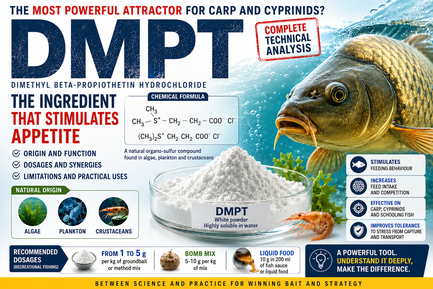
D.M.P.T.
The numerous questions regarding this substance require clarification and a thorough article on this "mysterious" ingredient, which will be followed by further articles dedicated to Betaine and all the most commonly used stimulants in competition fishing and beyond.
Let us immediately clear up the fact that this is a substance extracted from algae, plankton and certain types of crustaceans. A sulphur-containing amino acid compound very similar to Betaine, with which it shares the throne of "appetite stimulant", specifically aimed at cyprinids and schooling fish in general (such as Tilapia, widely farmed in Indochina, for which the substance was originally studied as a feed attractant for very low-quality diets).
The family of sulphur-containing amino acids includes Methionine, Cysteine, Homocysteine and Taurine, all of which have demonstrated attractive effects on carp (and for this reason have been mentioned in my books and recipes for years).
At this point it is important to clarify a fundamental concept. The reason why DMPT has attracted so much interest in the fishing world is not related to its nutritional value, but to its ability to stimulate the feeding behaviour of fish. These are two very different aspects. An ingredient can be excellent from a nutritional standpoint and at the same time go almost unnoticed by the fish's receptors. On the other hand, DMPT belongs to that category of substances that seem to signal the presence of a feeding opportunity, inducing fish to investigate and feed more decisively. This explains why its use has spread rapidly both in aquaculture and in recreational fishing, where an immediate feeding response is often sought more than any real nutritional contribution.
This chemical compound is known by numerous aliases such as:
Dimethyl-β-Propiothetin Hydrochloride, (2-carboxyethyl)dimethylsulfonium chloride, 3-dimethylsulfoniopropionate, beta-dimethylsulfoniopropionate, beta-DMSP, dimethyl-beta-propiothetin, dimethyl-beta-propiothetin chloride, dimethyl-propiothetin, dimethylpropiothetin, dimethylpropiothetin chloride, dimethylpropiothetin hydrochloride, dimethylsulfoniopropionate, dimethylsulfoniopropionate chloride, S-dimethyl-beta-propiothetin, S-dimethylsulfonium propionic acid, sulfonium, (2-carboxyethyl)dimethyl-, chloride (1:1).
According to data from the manufacturer Sustar, a Chinese giant specialising in feed chemistry, DMPT is a naturally occurring sulphur-containing compound and represents a new class of fourth-generation aquatic phagostimulants. The attractive effect of DMPT is said to be 1.25 times greater than choline chloride, 2.56 times greater than glycine betaine, 1.42 times greater than methylmethionine and 1.56 times greater than glutamine (one of the best amino acid-based attractants). The study concludes that DMPT is the substance with the strongest attractive effect.
The question many people ask at this point is whether DMPT can replace Betaine or make it obsolete. Personally, I do not see it in those terms. Although they belong to the same broad family of phagostimulants, the two products seem to occupy slightly different positions. Betaine is probably one of the most versatile substances ever used in bait formulation, while DMPT appears more focused on immediate feeding stimulation. If I had to simplify the concept, I would say that Betaine is an ingredient that contributes to building a good bait, while DMPT is a tool that can increase the speed and intensity of the feeding response. Naturally this is a simplification, and the two ingredients can coexist perfectly within the same strategy.
DMPT not only improves feed intake, but also acts as a water-soluble hormonal substance. DMPT also improves the ability to cope with stress associated with the capture and transport of fish and other aquatic animals.
These are obviously claims made by the manufacturer and should therefore be treated with caution, although the company is highly reputable and produces a considerable amount of scientific research that is regarded as reliable by experts in the sector (aquaculture, of course, not recreational fishing).
In fact, the manufacturer promotes its product with research aimed at demonstrating that it improves the flavour of tilapia flesh (otherwise considered rather bland), giving it a seafood-like taste.
Looking at the substance from a perspective that is more interesting for us, dimethylsulfoniopropionate (DMSP) is an organosulphur compound with the formula (CH₃)₂S⁺CH₂CH₂COO⁻. This zwitterionic metabolite can be found in marine phytoplankton, algae and certain species of terrestrial and aquatic vascular plants. It functions as an osmolyte, although many other physiological and environmental roles have also been identified. DMSP was first identified in the marine red alga Polysiphonia. This ingredient is produced synthetically due to the high cost and low purity of natural extraction methods, as well as the difficulty of industrial-scale production. The artificial synthesis of DMSP has been adapted for large-scale application by carrying out the chemical reaction of dimethyl sulphide and 3-chloropropionic acid in a solvent, thereby producing dimethyl-beta-propiothetin hydrochloride (DMPT).
The substance, sold as a white powder and highly soluble in water, has a heat stability declared by the manufacturer of around 100°C, and this is a weak point for its use in boilies (a use that I do not recommend). The manufacturer itself suggests inclusion in cold-pressed feeds and low-temperature extruded feeds.
There is also a similar product (Thiobetaine), L-(+)-Ergothioneine (ET), which is a sulphur-containing amino acid produced only by Actinomycetales bacteria and by fungi outside the Basidiomycota and Ascomycota divisions. It was originally isolated from Claviceps purpurea, commonly known as ergot. It is derived from L-histidine, which is converted into the betaine form known as hercynine. It is found in both animals and plants, and mammals generally obtain it through their diet, for example from mushrooms or oats.
Now that you have endured the whole lecture on "what it is", let us finally get to "how it is used", which is probably what interests you most.
Before continuing, however, I would like to point out that:
It cannot be administered to fish or animals in general under EU Regulation 1831/2003.
In other words, the product is illegal in Europe for feed use because the safety studies submitted by the Chinese manufacturer have not been validated (and I feel it is only fair to mention this).
Given the extreme concentration of the product, suggested dosages in recreational fishing range from 0.5 grams to 5 grams per kilogram of groundbait. Handling such small quantities is much easier if you first dissolve it in water or in any water-based liquid food and then mix it into your kilogram of groundbait or method mix.
(While the dosages suggested in feed manufacturing are around 100–200 grams per tonne.)
In my opinion, the best use is precisely in groundbait and method mixes, which are capable of creating feeding frenzy over a sufficiently large area where you will then place your rigs with hookbaits. It is no coincidence that the applications I find most interesting are those aimed at generating a rapid and widespread feeding response, a characteristic that is at the same time both the greatest strength and the greatest limitation of this substance.
Its inclusion in a bomb mix is certainly another highly suitable application. In this case I would increase the dosage to between 5 and 10 grams per kilogram of bomb mix.
The most stimulating synergy possible involves mixing DMPT with lysine, betaine, methionine and glutamine, creating a blend formulated respectively in proportions of 2-2-4-1-1, and then using it within the usual range of 1 to 10 grams per kilogram.
This combination is very effective with all cyprinids and can also be used in coarse fishing and feeder fishing groundbaits.
As already stated earlier, I do not feel comfortable recommending its use in boilies, although the compound just mentioned could become an interesting liquid food additive by dissolving 10 grams in every 200 ml of fish sauce or liquid liver. If boilies were to be produced using it, they should be cooked at 80°C (which requires an adjustable steam oven) for slightly longer than the normal cooking time at 100°C. This might allow the creation of soluble baits that could continue to be used during competition phases where catapults and groundbait balls are not permitted.
I hope I have clarified some doubts regarding this ingredient, and as always I remain available to subscribers for further clarification.
The limitation of DMPT in selective fishing
Before finishing, it is worth highlighting some mistakes that I frequently see when discussing this ingredient. The first is the belief that increasing the dosage will produce a proportionally greater effect. As is often the case with highly concentrated attractors, there is an optimal usage window beyond which the benefits tend to decline rapidly. The second mistake is adding it indiscriminately to any boilie without considering the temperature-related issues involved in processing. The third, and probably the most common, is assuming that a substance capable of increasing feeding activity is automatically the best choice for targeting large carp. In reality, strong feeding stimulation can quickly attract smaller fish and unwanted species as well, sometimes making it more difficult to achieve the final objective.
I also hope I have conveyed some practical concepts that help you move away from the mindset of "miracle substances". Many anglers look for the same thing in DMPT that they previously looked for in liquid amino acids, protein hydrolysates, betaine or dozens of other ingredients that periodically rise to prominence as potential game changers in carp fishing. The names change, the marketing changes, but the mental mechanism remains exactly the same: the search for a secret substance capable of solving every problem. The reality is that no attractor can replace proper watercraft, correct bait presentation and a strategy that is consistent with the situation we are facing. In modern carp fishing there is a tendency to consider any substance capable of increasing feeding activity as automatically positive. In reality things are far more complex. If our goal is to catch fish during competitions, increase the number of bites or stimulate a feeding response under difficult conditions, then ingredients such as DMPT can represent a very interesting resource.
The situation is different when the objective becomes targeting a single large fish, perhaps one of only a few present within a water containing large numbers of young carp, bream, crucians, catfish or other highly competitive species.
In these situations, strong feeding stimulation can even become counterproductive. The reason is quite simple: substances that increase the speed at which a fish detects and searches for a food source make no distinction between a sixty-pound carp and a ten-pound carp. In fact, it is often the younger, more social and more competitive fish that arrive on the spot first.
Anyone who has spent years targeting large carp knows very well that many old fish seem to live a parallel life compared to the rest of the population inhabiting the lake. They frequent different areas, exploit feeding windows that are often very short and rarely participate in the feeding competition typical of shoals of younger fish.
Creating a generalised feeding frenzy can therefore mean turning our spot into a sort of cafeteria frequented by every fish in the area. And when competition increases, biological noise on the spot increases as well. More fish moving around means more sediment being stirred up, more hookbaits being disturbed and a greater risk that the fish we are actually trying to catch remains on the edge of the situation or arrives only after the favourable window has closed. An ideal situation for those seeking numbers and continuous action, but not necessarily for those chasing a single exceptional specimen.
For this reason, when selectively targeting large carp, I often achieve better results using highly nutritious, recognisable and digestible baits that are free from excessive stimulants designed to mobilise every fish in the area. In other words, I prefer building confidence rather than creating feeding excitement. A large carp may take days or even weeks to become convinced that a particular food source represents a safe and worthwhile opportunity. Once that trust has been established, however, the advantage can become enormous.
Naturally, this is not an absolute rule. There are situations in which even a large fish may respond extremely well to these stimuli. Nevertheless, I believe it is important to understand that attraction and selectivity are not synonymous and that, very often, what increases the number of bites does not necessarily increase the chances of catching the fish we are actually trying to catch.
DMPT is certainly an interesting tool, but it remains simply one of the tools in the bait maker's toolbox. Like any tool, it can make a difference in the right hands, or prove completely irrelevant when used in the wrong context. Like any tool, it can make a difference in the right hands, or prove completely irrelevant when used in the wrong context.
In winter, when the water is lifeless and fish activity is virtually absent, this may be a card worth playing even on public waters or outside competition situations, although in truly impossible conditions the best strategy remains a micro pop-up surrounded by a little ring of lively maggots!
Before closing, I would also like to remind you that DMPT is only the first piece of a much broader picture. In the coming weeks I will publish two further articles dedicated to Betaine and amino acids, completing a trilogy focused on some of the most discussed feeding stimulants in modern bait formulation. The goal is not to identify a miracle ingredient, but to better understand how these substances work, where they fit into a baiting strategy and, above all, where their real limits lie.
If these subjects interest you, and you would like to explore them beyond the necessarily concise format of a blog article, I recommend reading Boilies, The Art and Science of Carp Bait. Within its pages you will find extensive sections dedicated to attractors, amino acids, hydrolysates, feeding stimulants, liquid foods, bait formulation and practical recipes, together with the reasoning that links fish nutrition, aquaculture research and modern carp bait design.
Book link: