
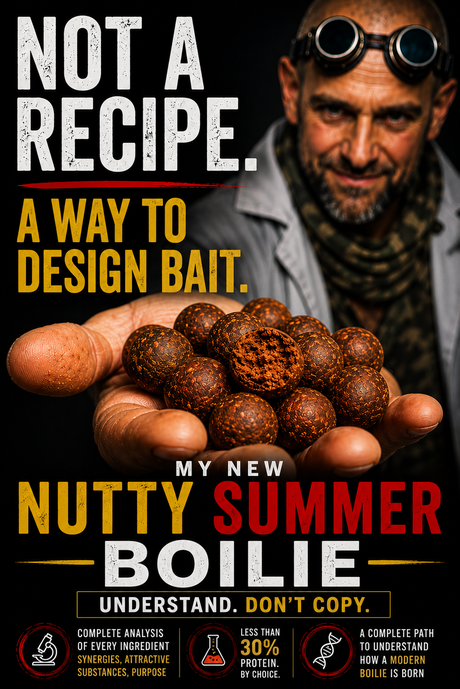
Summer Nutty Boilies: More Than a Recipe
Over the last few months we've explored some of the most important feeding triggers used in modern bait formulation. We've looked at betaine, DMPT, free amino acids and many of the compounds that science has shown to stimulate a carp's feeding response.
Those articles were written to answer one simple question: why does a carp decide to feed?
This article takes the next step.
Rather than looking at individual ingredients, we're going to build an entire boilie from the ground up, analysing every single component and, more importantly, understanding why each one has earned its place in the recipe.
What you're about to read isn't just another summer boilie recipe.
It's a complete bait design project.
We'll look at every ingredient in both the dry mix and the liquid food, discussing not only its nutritional value but also the chemical compounds it contributes, how it interacts with the other ingredients and why, together, they create a feeding profile that's very different from most boilies available today.
I deliberately moved away from the trend of building increasingly extreme recipes.
You won't find huge amounts of fishmeal, exotic ingredients or a pointless race towards the highest possible protein level. Instead, this bait is built around processed cereals, brewer's yeast, fermented products, vegetable ingredients and a carefully selected animal component. The result is a boilie with a rich, distinctive taste and a highly attractive feeding profile, while remaining something that carp are unlikely to regard as familiar.
And that's an important point.
The biggest carp are also the oldest and the most experienced. Throughout their lives they've encountered thousands of boilies built around the same fishmeals, the same birdfoods, the same flavours and often the same overall concept. That doesn't mean those baits no longer work. Far from it.
But presenting something genuinely different—without becoming strange or unnatural—can offer a real advantage.
Not because it smells stronger.
Because it speaks a different chemical language.
Another goal of this article is to show that great boilies aren't built around miracle ingredients.
They're built around balance.
The real strength of any formulation lies in the way individual ingredients work together. That's why we'll take our time to examine every decision behind this recipe, explaining not only what each ingredient does, but how a bait maker approaches the process of designing a boilie from a blank sheet of paper.
This is the recipe I use when targeting big carp during the warmer months, particularly on waters rich in natural food. I don't claim it's the perfect bait for every situation—because no such bait exists—but it does represent the way I believe modern bait formulation should be approached: combining biology, nutrition, food technology and decades of practical experience into one coherent recipe.
The Recipe
Before we look at each ingredient in detail, here's the complete recipe.
At first glance it may seem surprisingly simple. The ingredients are easy to source, reasonably priced and don't require any specialist suppliers.
That's intentional.
The real value of this bait isn't hidden in an exotic ingredient or an expensive additive. It's in the way every component has been selected to work with the others. That's exactly what we'll explore throughout the rest of this article.
Dry Mix
-
30% Micronised brewer's grains & brewer's yeast pellets
-
20% Re-milled durum wheat semolina
-
20% Full-fat toasted soya flour
-
20% Micronised dried bread
-
10% Skimmed milk powder
Liquid Food
Blend together equal parts of:
-
100% Peanut Butter
-
Fermented Shrimp Paste
-
Double or Triple Concentrated Tomato Paste
-
Naturally Brewed Soy Sauce
Blend until you obtain a smooth, homogeneous liquid food.
Liquid Ingredients for 1 kg of Dry Mix
-
100 ml of the liquid food
-
3 drops Butyric Acid
-
6 drops Red Thyme Essential Oil
-
5–6 eggs, depending on the consistency of the paste
One small trick I've used for years is to keep the entire mix as cool as possible while making the bait.
During the summer, especially on very hot days, I like to keep the eggs in the fridge—or even in the freezer for a couple of hours before mixing.
Working at a lower temperature helps preserve some of the more volatile compounds in the liquid food, slows down unwanted enzymatic activity and produces a firmer, more stable paste that's much easier to roll.
Now that you've seen the complete formulation, we can start looking at every ingredient in detail.
By the end of this article, I hope you'll realise that behind what appears to be a fairly straightforward recipe lies a carefully planned bait design, where every ingredient has a specific purpose and every choice contributes to the final result.
Brewers' Grains & Brewer's Yeast: The Heart of the Recipe
As you've already seen, this ingredient makes up 30% of the entire dry mix. That's a significant proportion, so it's worth taking the time to understand why it plays such an important role.
The product I use is a pellet made for horse nutrition by the German company Höveler. I've included a link to the manufacturer's website because I want you to see exactly what I'm using. It also makes life easier for readers outside Italy, who can either buy the same product or look for something with a similar composition in their own country.
The first thing I'd like to point out is this.
Don't dismiss it simply because it's sold as horse feed.
One of the biggest mistakes in bait making is believing that the best ingredients are those marketed specifically for carp fishing. My experience has taught me the exact opposite.
Some of the finest raw materials I've ever used came from the food industry or from animal nutrition, not from tackle shops.
These industries invest heavily in research, ingredient quality and nutritional consistency because they're feeding valuable animals. Those same qualities make many of their products extremely interesting for bait formulation.
This particular pellet is mainly made from brewers' grains and brewer's yeast, with smaller amounts of extruded linseed and wheat bran.
It may look like a simple ingredient.
In reality, it's remarkably sophisticated.
Brewers' grains are what remain after malted barley has been used during the brewing process. As the barley is malted, naturally occurring enzymes begin breaking down starch into fermentable sugars. Those sugars are then extracted, leaving behind proteins, fibre, lipids, minerals and a wide range of aromatic compounds created during the malting process.
That alone would make brewers' grains a worthwhile ingredient.
The addition of brewer's yeast takes things to another level.
Brewer's yeast contributes far more than protein. It naturally contains peptides, free amino acids, nucleotides, B vitamins and complex polysaccharides such as beta-glucans and mannan oligosaccharides. These compounds are produced during yeast growth and fermentation, creating a nutritional profile that's both rich and biologically interesting.
What makes this ingredient so appealing isn't that it sends one strong feeding signal.
It sends several at the same time.
The brewers' grains tell the story of processed cereals, malt and fermentation. The yeast adds another layer of microbial activity and naturally fermented compounds. Together they produce exactly the kind of chemical signals carp encounter throughout their lives while feeding over lakebeds rich in decaying plant material and microbial activity.
This is one of the key ideas behind the whole recipe.
I wasn't trying to build something aggressive.
I wanted something believable.
Over the years we've seen an endless race towards stronger flavours, more concentrated attractors and increasingly complex formulations. Yet the biggest carp in the lake have already seen thousands of boilies based around the same concepts.
I wanted to offer them something different.
Not something strange.
Something unfamiliar, but completely natural.
A bait that speaks a different chemical language without ever becoming suspicious.
There's another reason I like this ingredient so much.
Because it comes as a small, hard pellet, it can easily be ground into a fine meal and incorporated into the dry mix. At the same time, the pellets themselves can be used whole or lightly crushed in PVA bags or mesh.
That creates what I like to call nutritional continuity.
The loose feed surrounding the hookbait isn't simply similar to the boilie.
It's made from exactly the same ingredient.
The chemical signals released by the feed are identical to those coming from the hookbait itself. As the carp approaches the spot, every mouthful tells the same story.
It might sound like a small detail, but I believe it's one of the most elegant ways of making a bait presentation more convincing.
In nature, food doesn't suddenly change its chemical profile within a few centimetres.
The more consistent we can make the entire feeding area, the more believable our presentation becomes.
And that's a principle you'll notice throughout this recipe.
Every ingredient has a specific job to do.
None of them is there simply to fill space.
The next ingredient is a perfect example of that philosophy. At first glance it looks ordinary, but without it the whole structure of the bait would be very different.
That's where re-milled durum wheat semolina comes in.
Re-milled Durum Wheat Semolina: The Framework of the Bait
Now that we've established the nutritional foundation of the recipe, it's time to build the structure that allows every other ingredient to do its job.
That's where re-milled durum wheat semolina comes in.
At first glance it might seem like one of the least exciting ingredients in the mix. In reality, I've learned over the years that the simplest ingredients are often the ones that determine whether a bait performs well or not.
A boilie isn't judged only by what's inside it.
It also has to survive mixing, rolling, boiling, drying, casting and, finally, several hours on the lakebed. Throughout that entire process it must remain mechanically stable while still allowing water to penetrate and soluble compounds to leave the bait at the right speed.
That's a difficult balance to achieve.
Durum wheat semolina plays a major role in making it possible.
As the dough is mixed, gluten proteins absorb water and begin forming a strong elastic network. This gluten structure binds the other ingredients together, giving the paste its strength, elasticity and consistency. It's one of the reasons the finished boilies roll cleanly, keep their shape during boiling and remain stable once they reach the lakebed.
But its job doesn't end there.
That same structure also regulates the movement of water through the bait.
A boilie that's too soft often releases a large proportion of its attractors very quickly, producing an intense but short-lived feeding signal. At the other extreme, a bait that's excessively hard can slow water penetration so much that it takes far too long before the soluble compounds begin working properly.
Like so many things in bait making, the best solution lies somewhere between those two extremes.
At 20% of the mix, re-milled semolina gives this recipe exactly the balance I was looking for. It provides enough strength to support a liquid food rich in peanut butter, fermented shrimp paste and other viscous ingredients, while still allowing the bait to activate naturally once it reaches the bottom.
There's another reason why I continue to use it after all these years.
Semolina has a very neutral flavour.
Some anglers see that as a weakness.
I see it as one of its greatest strengths.
It doesn't compete with the more distinctive ingredients in the recipe. Instead, it provides a stable foundation that allows the toasted soya, brewer's grains, fermented products and liquid food to define the bait's overall character.
I've always believed that good bait formulation is much like building a house.
Everyone notices the roof, the windows and the decoration.
Very few people think about the foundations.
Yet without strong foundations, nothing else performs as it should.
Semolina is one of those foundations.
It rarely attracts attention when someone reads the recipe, but it's one of the main reasons why the finished boilie performs exactly as intended.
Dried Bread: Far More Than a Cheap Filler
If I had to list the most underrated ingredients in bait making, dried bread would certainly be near the top.
For many anglers it's nothing more than an inexpensive filler, useful for reducing the overall cost of a mix. I see it very differently.
Bread is actually a remarkably sophisticated ingredient.
Before it becomes dried breadcrumbs, it has already gone through several important transformations. The flour has been mixed, fermented by yeast and finally baked. During these stages the starches gelatinise, the proteins change their structure and hundreds of aromatic compounds are produced.
Once the bread is dried and finely ground, what remains is a highly porous material with excellent absorbency.
And that's exactly why it's included in this recipe.
One of the main objectives of this bait was to build a liquid food capable of carrying a wide range of attractive compounds. Peanut butter, fermented shrimp paste, tomato concentrate and soy sauce all bring valuable nutrients and chemical signals, but they also introduce a considerable amount of moisture and viscosity into the mix.
The dry ingredients therefore need to absorb that liquid evenly.
Dried bread does this exceptionally well.
I often think of it as thousands of tiny natural sponges spread throughout the boilie.
During mixing they absorb part of the liquid food, helping to distribute it evenly through the paste. Once the boilie is submerged, those same microscopic pores gradually allow water to move in and soluble compounds to move out.
In other words, bread doesn't simply hold the liquid.
It actively participates in the way the bait works underwater.
There's another interesting point.
The baking process produces a wide range of Maillard reaction compounds, the same family of molecules responsible for the aroma of freshly baked bread, roasted cereals, toasted nuts and coffee.
Carp obviously don't smell these foods in the same way we do.
What they detect is the complex mixture of soluble compounds associated with highly digestible energy sources. Once again, the aim isn't to create an artificial flavour profile, but to take advantage of compounds that occur naturally during food processing.
The 20% inclusion rate wasn't chosen by chance.
It's enough to provide excellent absorbency and improve the behaviour of the liquid food without making the finished bait too soft or mechanically weak. Together with the semolina, it creates a boilie that's firm enough to withstand handling and boiling, while remaining open enough to become active as soon as it reaches the lakebed.
This is another example of a principle I've followed for many years.
The best ingredients aren't always the rarest or the most expensive.
Very often they're the ones we've known all our lives but never really understood.
In this recipe, dried bread isn't there to fill space.
It's there to help every other ingredient perform at its very best.
Full-Fat Toasted Soya Flour: Where Nutrition Meets Flavour
The fourth ingredient in the recipe is full-fat toasted soya flour, included at 20% of the dry mix.
Like every other ingredient we've looked at so far, it wasn't selected simply because of its protein content.
Soya has been part of boilie recipes for decades, but it's often treated as though every type of soya flour performs in exactly the same way.
That simply isn't true.
The way it's processed, whether the oil has been removed, how it's heat-treated and even the final particle size all influence the way it behaves in a bait.
For this recipe I specifically chose a full-fat toasted soya flour because it retains the natural oil found in the bean. Those oils are rich in unsaturated fatty acids, phospholipids and, most importantly, lecithin.
Lecithin is one of nature's most effective emulsifiers.
That may sound like a minor technical detail, but it plays a surprisingly important role in this bait.
The liquid food contains a relatively high proportion of peanut butter, which brings valuable oils along with its flavour and nutritional value. Lecithin helps disperse those oils evenly throughout the paste, producing a far more stable and homogeneous mixture.
Rather than allowing pockets of oil to remain trapped in certain areas of the bait, the liquid ingredients become evenly distributed throughout the entire boilie.
It's one of those small details that most anglers never notice.
Yet it's exactly these details that separate a well-designed bait from one that's simply a collection of ingredients.
Then there's the effect of toasting.
Heat treatment does much more than improve shelf life or reduce naturally occurring anti-nutritional factors found in raw soya.
It completely changes the character of the ingredient.
During toasting, Maillard reactions create hundreds of aromatic compounds responsible for the warm, roasted flavour that makes toasted soya so much more appealing than raw soya.
Once again, this recipe follows the same philosophy we've seen from the beginning.
I'm not trying to create an aggressive bait based on artificial flavours.
I'm trying to build a boilie with a rich, natural taste, developed through carefully selected raw materials and the way they're processed.
Nutritionally, soya contributes high-quality protein, valuable lipids, essential fatty acids and a balanced supply of carbohydrates.
But that's not the main reason it's here.
Its real job is to connect different parts of the recipe.
The brewers' grains and yeast establish the fermented cereal profile.
The bread manages the liquid phase.
The semolina provides structure.
The soya sits right in the middle, linking the dry mix to the liquid food.
This becomes even more obvious when we reach the peanut butter.
Both ingredients come from oil-rich seeds.
Both develop complex roasted flavours during heat treatment.
Both contribute lipids that complement one another rather than competing.
Together they create a smooth transition between the dry mix and the liquid phase, giving the finished bait a much more natural and harmonious flavour profile.
That's also why I deliberately avoided adding peanut flour to the dry mix.
I wanted the peanut character to come entirely from the liquid food, allowing the soya to support it without simply repeating the same message.
One of the biggest mistakes in bait formulation is assuming that adding more of a similar ingredient automatically improves the bait.
In reality, it often does the opposite.
A well-designed recipe isn't about repeating the same feeding signal over and over again.
It's about allowing each ingredient to make its own unique contribution while working in perfect harmony with everything else.
Skimmed Milk Powder: Completing the Recipe Without Overcomplicating It
The final ingredient in the dry mix is skimmed milk powder, included at 10%.
It may seem like a relatively small addition, but it plays several important roles in the overall formulation.
Once again, I deliberately chose the simpler option.
Technically speaking, I could have used whey protein concentrate (WPC), casein, calcium caseinate or other refined milk proteins. I've worked with all of them over the years, and there's no doubt they offer certain advantages in specific formulations.
That wasn't the objective here.
This recipe wasn't designed to be the most sophisticated boilie I could possibly make.
It was designed to be effective, balanced and easy for any angler to reproduce.
Skimmed milk powder contributes high-quality milk proteins, mainly caseins and whey proteins, together with lactose and naturally occurring minerals. As those proteins are digested they release peptides and amino acids that further enrich the bait's nutritional profile.
Its contribution isn't dramatic.
It's subtle.
And that's exactly why it fits so well into this recipe.
From a practical point of view it also improves the texture of the paste, making it smoother, easier to mix and more consistent during rolling. It helps produce a cleaner finish after boiling and contributes to the overall stability of the bait without making the mix unnecessarily complicated.
I also like what it brings to the flavour profile.
Milk proteins have a naturally soft, rounded taste that blends remarkably well with the toasted cereals, fermented ingredients and peanut butter used throughout this recipe.
Nothing dominates.
Everything supports everything else.
That has been the guiding principle from the very beginning.
The 10% inclusion rate was chosen for another reason as well.
One of my objectives was to keep the overall protein level deliberately moderate.
Over the last few years we've seen more and more anglers chasing increasingly high protein levels, almost as though the quality of a boilie could be measured simply by reading the nutritional label.
I've never believed that.
Modern summers are becoming hotter and hotter. Water temperatures remain high for long periods, dissolved oxygen levels often fall and feeding behaviour becomes far less predictable than many anglers assume.
A carp's metabolism may still be active, but its feeding opportunities can become surprisingly limited.
Instead of grazing continuously throughout the day, fish often concentrate their feeding into relatively short windows, usually during the coolest parts of the day or night.
Those conditions require a different way of thinking.
Rather than building a bait that's as nutritionally dense as possible, I wanted one that fish could continue eating without becoming satisfied too quickly.
That's why I deliberately kept the finished bait below 30% crude protein.
Not because I believe high-protein boilies are wrong.
They certainly have their place.
But in this particular situation I wanted a bait that relied more on digestibility, chemical attraction and feeding stimulation than on overwhelming nutritional density.
There can be a fine line between a highly attractive bait and one that satisfies a fish after only a few mouthfuls.
My aim was to stay on the attractive side of that line.
Before we move on to the liquid food, I'd like to make one final point about the dry mix.
From a purely technical perspective, it could certainly have been made even more sophisticated. Replacing the skimmed milk powder with WPC, casein or caseinate would have improved binding, emulsification and the overall mechanical properties of the finished bait.
I've used those ingredients many times and still do in certain specialist formulations.
But that wasn't the point of this project.
I wanted to show that an excellent boilie doesn't have to rely on expensive or difficult-to-source ingredients.
Good bait formulation isn't about how much money you spend.
It's about understanding what every ingredient contributes and combining them with a clear purpose.
A simple recipe built around sound principles will almost always outperform a complicated one assembled without real thought.
That's the philosophy behind this bait.
And it's the same philosophy that will guide us through the most important part of the recipe...
the liquid food.
The Liquid Food: Building the Bait's Feeding Profile
Up to this point we've looked at the dry ingredients that make up the structure of the bait. They provide the mechanical properties, much of its nutritional value and the foundation on which the whole recipe is built.
The liquid food has a different job.
This is where much of the bait's feeding profile comes from. It contributes highly soluble compounds, complements the dry mix and gives the finished boilie its own identity. For that reason I always spend a great deal of time thinking about the liquid ingredients. In many cases I consider them even more important than the dry mix itself.
The idea behind this recipe was never to produce an aggressive bait with one dominant flavour.
I wanted every ingredient to contribute something different while remaining perfectly balanced with the others.
The first decision was to move the entire nutty profile into the liquid food by using 100% peanut butter instead of peanut flour.
There are several reasons for this.
Peanut butter still contains all of the bean's natural oils together with its proteins and the compounds developed during roasting. It also mixes extremely well with the rest of the liquid ingredients, producing a smooth and stable liquid food that's easy to incorporate into the dry mix.
More importantly, it creates a natural link with the full-fat toasted soya flour.
Both ingredients come from oil-rich seeds, both develop similar roasted notes during processing and both contribute valuable lipids to the finished bait. Rather than repeating the same ingredient in different forms, I preferred to let the soya support the peanut butter naturally. The result is a much cleaner and more balanced flavour profile.
The next step was to introduce a completely different type of food signal.
For that I chose tomato paste and naturally brewed soy sauce.
Tomato paste is one of those ingredients that rarely receives the attention it deserves. Besides its concentrated flavour, it contains naturally occurring glutamates, organic acids and sugars that become far more concentrated during processing.
Soy sauce reaches a similar point through fermentation rather than concentration. During the fermentation process proteins are broken down into peptides and free amino acids, creating a liquid that's naturally rich in soluble nitrogen compounds.
Although these two ingredients are completely different, they complement each other remarkably well.
The tomato contributes sweetness, acidity and natural glutamates, while the soy sauce adds fermented amino compounds and extra depth to the overall feeding profile.
Finally we come to the fermented shrimp paste. (how is it made? video here)
I deliberately chose a fermented product rather than a conventional shrimp extract because fermentation changes the chemistry of the ingredient. Large proteins are partially broken down into smaller peptides and free amino acids, producing compounds that dissolve readily in water and are easily detected by the carp's chemoreceptors.
The aim wasn't to create a fishmeal bait.
Nor was it to produce a bait that smelled strongly of shrimp.
The shrimp paste simply introduces another group of natural feeding compounds that fits perfectly with the rest of the recipe.
When all four ingredients are blended together something interesting happens.
No single ingredient dominates the others.
The peanut butter doesn't overpower the tomato.
The soy sauce doesn't hide the shrimp paste.
Instead they produce a feeding profile that combines roasted seeds, fermented vegetable products and fermented animal proteins in a very natural way.
That's exactly what I was hoping to achieve.
I've never believed that adding more and more ingredients automatically creates a better bait. In my experience the opposite is often true. A shorter ingredient list, where every component has a clear purpose, usually produces a far more consistent result than a complicated recipe full of overlapping functions.
To complete the liquid food I add three final ingredients.
The first is butyric acid.
Only three drops per kilogram of dry mix are needed. At this level it doesn't dominate the recipe but simply broadens the overall feeding profile with a light fermented note.
The second is Red Thyme Essential Oil, used at six drops per kilogram.
Anyone who has read my previous work will already know how much confidence I have in this essential oil. I don't use it because it's fashionable or because it has a particularly strong aroma. I use it because, in small amounts, it blends exceptionally well with the other ingredients and gives the finished bait a very distinctive but natural character.
The last ingredient is, of course, the eggs.
Besides binding the mix together, eggs help emulsify the oils present in the liquid food and contribute additional proteins and phospholipids to the finished bait.
One small tip I'd recommend, particularly during the summer, is to use cold eggs. Keeping them in the fridge, or even in the freezer for a short time before mixing, makes the paste easier to work with and helps preserve some of the more delicate compounds present in the liquid ingredients.
Once the liquid food is mixed into the dry ingredients, the recipe is complete.
At that point every part of the bait is working towards the same objective. The dry mix provides the structure, the liquid food supplies the chemical signals, and together they produce a boilie that reflects exactly the philosophy I've tried to describe throughout this article.
If you've read this article from beginning to end, I hope you've taken away more than just another boilie recipe.
My real intention wasn't simply to share one of my summer baits.
It was to explain the thought process behind it.
Every ingredient was chosen for a reason. Every percentage has a purpose. Every part of the recipe contributes to the final result.
That's how I've always approached bait formulation.
I don't start with a list of fashionable ingredients and try to fit them together afterwards.
I start with an objective, then choose the ingredients that best help me achieve it.
Sometimes that leads to a very simple recipe.
Sometimes it produces a much more complex one.
The important thing is that every ingredient earns its place.
Over the years I've realised that many anglers spend too much time searching for the perfect ingredient and not enough time understanding how ingredients work together.
In my opinion, that's where the biggest improvements can be made.
Learning to formulate bait isn't about memorising recipes.
It's about learning to think differently.
That has always been the philosophy behind my work, and it's exactly the approach I developed in my book Boilies,the Art and Science of Carp Bait
The book goes far beyond individual recipes.
It explains the principles of bait formulation, ingredient selection, nutritional balance, liquid foods, attractors and practical bait making techniques developed through decades of testing on the bank.
If this article has changed the way you look at a boilie, I believe the book will help you develop the same approach when designing your own.
Thank you for taking the time to read this article.
I hope the recipe catches plenty of carp.
But even more than that, I hope it encourages you to look at bait making with a little more curiosity and a little more understanding.
The recipe is only the starting point.
Knowing why it works is where the real journey begins.