Replicating Starbaits Hot Demon Boilies – A Self-Made Approach
Why replicate ready-made boilies?
There was a time when I used to offer free consultancy on bait development—mixes, liquid attractors and bait design in general. Anyone could fill out a form, submit a project, and I would provide full professional guidance through every stage of the development process.
During that period I received many requests to replicate well-known ready-made boilies and, whenever possible, we managed to achieve some very interesting and rewarding results—both in terms of fishing performance and personal satisfaction for those who developed them.
Starbaits is a French company that hardly needs any introduction. It has been present in the bait market since the early days, thanks to the pioneering work of the Mahin brothers. And what about Sensas, the giant that owns the Starbaits brand and is a world leader in match fishing?
It’s no surprise then that Starbaits boilies hold a special place in the hearts of many anglers. Over the years, many carp anglers have wondered whether it would be possible to faithfully reproduce their favourite baits at home.
In fact, this isn’t the first Starbaits boilie I’ve worked on replicating—and that says a lot about the quality of the French company’s bait concepts, which have clearly stood the test of time in terms of reliability and success.
The Hot Demon Replica Project
The idea of replicating Hot Demon was proposed by an experienced carp angler with solid knowledge of self-made bait. From the very beginning it was clear that by combining our skills we could achieve a very good result—especially thanks to his ability to identify certain ingredients simply by smell, an essential skill when aiming for a faithful replica.
However, an important clarification is necessary.
The goal is not to replicate the exact industrial production system used by Starbaits (which, incidentally, uses alginic acid instead of eggs). Instead, the objective is to adapt the concept to a high-quality self-made boilie, resulting in a customised bait that remains very close to the original.
Will it be identical? Worse? Better?
That depends on perspective.
What is certain is that a handmade, personalised bait offers an undeniable advantage: every capture becomes even more satisfying when the fish is caught on a bait you designed and rolled yourself.
For a proper replication project it is essential to have the original boilie available for comparison—visually, by smell, by taste, and of course by testing the prototype side by side on the bank with the reference bait.
This approach allows us to confirm that the final result can be extremely close to the original—as in this case.
Analysing the Original Ingredients
The first step in any replication project is analysing the solid ingredients listed on the packaging, which by law must appear in descending order of quantity.
At this stage I estimate the likely inclusion rates by cross-referencing several factors:
-
production cost
-
wholesale price of the ingredient
-
realistic inclusion levels within a commercial bait
During this phase we quickly realised that some ingredients would be easier—and more cost-effective—to include in liquid form rather than as powders. This also improves hydration management and results in a highly hydrated bait, which is already designed to work quickly in the water.
Base Mix (Dry Ingredients)
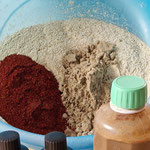
The base mix we developed is composed as follows:
-
40% re-milled durum wheat semolina
-
25% toasted soybean flour
-
15% self-made Robin Red
-
10% predigested fishmeal
-
7% skimmed milk powder
-
3% betaine
Some differences compared with the ingredient list of the commercial bait are inevitable. These adjustments are necessary to create a mix that rolls properly with six eggs per kilogram of dry ingredients.
The relatively high inclusion level of Robin Red is due to the use of a self-made technical version of the ingredient. If you are not familiar with Robin Red replication recipes, you can find them linked below.
(A very low-cost alternative can be made by mixing hot paprika and muscovado sugar in equal parts.)
Different versions of this birdfood mix may slightly change the final colour of the boilies, but in this project we considered colour a secondary factor.
Skimmed milk powder helps improve the plasticity of the dough when rolling on home bait tables.
Hemp was deliberately omitted. While it can improve visual appeal, it tends to reduce the long-term stability of the bait without offering any real practical advantages.
Under normal environmental conditions, this mix rolls perfectly with six medium eggs per kilogram.
Liquid Attractor Package
The liquid phase is where the real attraction power of these spicy boilies comes from.
Hot Demon-style baits are not designed for heavy long-term baiting campaigns. Instead, they are meant to trigger quick attraction and fast bites, even without pre-baiting.
As I often say:
Solids feed the fish.
Liquids attract them.
For this reason, ingredients such as liver and yeast, which appear as solids in the commercial recipe, are used here in liquid form. This allows better hydration and more precise dosage.
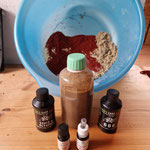
Liquid mix (per 1 kg of dry mix)
-
50 ml propylene glycol (E1520)
-
25 ml liquid liver
-
25 ml liquid yeast
-
6 ml squid flavour (manufacturer dosage)
-
3 ml Indian spice flavour (manufacturer dosage)
-
10 drops red thyme essential oil
-
5 drops chilli essential oil
-
5 ml NHDC sweetener
Propylene glycol acts as the carrier solvent, allowing all liquid components to be blended into a single solution before being added to the mix.
This blend can be prepared several days in advance, allowing the ingredients to fully integrate.
Besides acting as a solvent, glycol is also an excellent humectant, helping the boilies remain soft—very similar to the reference ready-made bait.
Key Attractors: Liver and Yeast
Liquid liver and yeast represent the core attraction system of the recipe.
Both ingredients are highly soluble and provide constant leakage of attractants throughout the operational life of the boilie.
In our case, both liquid foods were home-made through fermentation and predigestion.
For anglers who do not yet produce their own liquid foods, good quality commercial alternatives can be used.
Aroma and Spice Profile
Recreating the aromatic profile required careful sensory analysis—almost like a bait sommelier tasting and smelling the original boilie.
It may sound strange, but this is often the only reliable method.
Even advanced spectrographic analysis struggles to identify complex blends of flavourings and essential oils, whereas a trained nose can sometimes detect what instruments cannot.
A memorable example dates back to the late 1990s, when I first attempted to replicate Robin Red. A friend of mine—an experienced wine sommelier—managed to identify most of the spices simply by smelling the original product.
In the case of Hot Demon, the key characteristic turned out to be the distinct note of red thyme, supported by the spicy kick of chilli oleoresin.
Spiciness can also be achieved using habanero extracts or pure capsaicin, but the dosage would need to be recalibrated.
The NHDC sweetener provides the typical round sweetness found in many modern ready-made boilies.
Preserving the Boilies
If you plan to store the boilies in bags without freezing, it is advisable to add:
-
5 g vitamin C
-
5 g calcium propionate
Allow the boilies to air-dry for at least 24 hours before bagging.
Alternatively, you can simply freeze the bait the day after cooking.
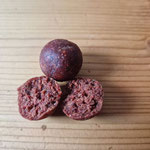
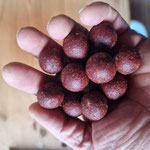
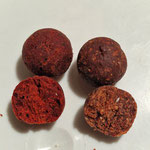
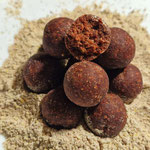
The boilies shown in the gallery were steam-cooked.
Final Thoughts
If you decide to try this project, I wish you the best of luck.
Remember that you can also use only the liquid package, applying it to a simple birdfood mix or classic 50/50 base mix. This will produce a simplified flavour-based version of the bait that can still be very effective.
I’ll leave you with the images in the gallery, which illustrate the project and the final result.
Enjoy the view—and tight lines.
Discover the science behind carp bait design. Get the book here.