
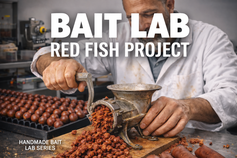
Red Fish Boilies
A modern spiced fish mix designed for fast attraction and big carp
A complete guide to making Red Fish boilies: a spiced fish mix recipe designed for fast attraction, big carp fishing, and adaptable baiting strategies for modern carp angling.
Red Fish Boilies
A modern interpretation of a classic spiced fish mix
The name Red Fish is very important to me. It represents one of the most successful bait projects from my past, developed when I was working as a bait consultant designing products for Big Fish.
Back in the late 1990s the carp fishing world was already moving toward a very clear direction. Among the different bait families available at the time, spiced fish mixes quickly rose to the top of anglers’ preferences, mainly because of the incredible results they were producing on the bank.
Those baits worked because they combined several powerful feeding triggers: fish meal proteins, amino acids, strong natural aromas and spicy compounds capable of stimulating carp feeding behaviour.
The idea behind this recipe is simple but very precise.
I wanted to combine the winning stimulation patterns of classic fish mixes with the fast response expected from modern high-performance baits.
Today many anglers fish short sessions or heavily pressured waters. In these conditions, a bait must not only be nutritionally credible, but it must also enter the swim quickly, releasing attraction signals that can immediately activate feeding behaviour.
For this reason, the mix used in this recipe has been designed to be:
-
relatively economical
-
nutritionally attractive
-
strong in taste
-
resistant enough to remain effective in water
-
capable of releasing attraction quickly
The liquid package, which we will analyze later, plays a fundamental role in achieving this rapid attraction effect. Its purpose is to create a direct feeding stimulus aimed particularly at larger carp, which are constantly searching for the most rewarding and energy-efficient food sources.
Base Mix Composition
The dry mix used for these boilies is composed as follows:
-
30% re-milled durum wheat semolina
-
20% fine maize flour
-
20% LT herring meal
-
15% WPC80 (whey protein concentrate)
-
10% sweet paprika powder
-
3% muscovado cane sugar or powdered molasses
-
2% monosodium glutamate
At first glance this mix may appear simple, but each ingredient has been selected for a very specific technical reason.
Structural ingredients
Semolina and maize flour provide the structural framework of the boilie. They ensure proper binding, good rolling properties and the correct level of hardness once the bait is cooked.
A boilie that is too hard prevents the release of attractors.
A boilie that is too soft breaks down too quickly.
This balance allows the bait to maintain good durability while still exchanging soluble signals with the surrounding water.
Fish meal component
The LT herring meal provides the core nutritional signal of the bait.
Low-temperature fish meals preserve a higher proportion of amino acids and natural attractants compared to standard fish meals. This makes them particularly valuable when targeting larger carp.
Milk protein fraction
WPC80 introduces highly digestible protein and also contributes to improving the bait’s solubility and mouthfeel.
In many cases, milk proteins act as palatability enhancers, encouraging carp to hold the bait in the mouth longer.
Spices and feeding triggers
Paprika plays a key role in the identity of this bait. Beyond its red coloration, paprika introduces natural oils and spicy aromatic compounds that carp seem to respond to extremely well.
Muscovado sugar or powdered molasses adds minerals and a slight sweetness that complements the savoury signals produced by the fish meal.
Finally, monosodium glutamate functions as a taste amplifier, increasing the perception of umami flavours once the bait is inside the carp’s mouth.
The result is a strong fish mix capable of producing intense feeding signals without causing rapid satiety.
The Liquid Package: The Heart of Attraction
In modern bait design, liquids often represent the most important part of the recipe.
While the base mix defines structure and nutritional signals, the liquid ingredients determine how quickly and effectively the bait begins communicating with the fish.
In this recipe the liquid package is designed to support two different attraction mechanisms.
Primary attraction
These are the signals that disperse in the water and help fish locate the baited area.
Secondary attraction
These are the taste signals that activate once the carp takes the bait into its mouth.
The liquid package used in this recipe works on both levels.
Liquid package (per kg of base mix)
-
150 ml fermented fish sauce
-
50 ml propylene glycol
-
20 g Carpix Sensas
-
10 g lysine
-
10 g betaine
-
10 drops red thyme essential oil
Fermented fish sauce is one of the most powerful liquid attractors available. Products such as Tiparos or Squid Brand contain extremely high levels of soluble amino acids and peptides produced through fermentation. (If you want to go deeper into this ingredient, I have also written a complete guide explaining how to produce fermented fish sauce for carp bait at home.)
Propylene glycol works as a carrier and stabilizer, helping distribute aromatic compounds evenly within the bait.
Carpix Sensas adds an additional feeding stimulant commonly used in coarse fishing.
Lysine and betaine strengthen the amino acid signal and improve palatability.
Finally, red thyme essential oil introduces a subtle spicy aromatic signature that complements the paprika contained in the mix.
Preserving the Boilies
Once rolled and cooked, boilies must be preserved properly.
If you plan to store the baits in sealed bags after drying, you should add:
-
5 g potassium sorbate
-
3 g calcium propionate
These ingredients prevent mould formation and extend the shelf life of the bait.
Alternatively, after 24 hours of air drying, the boilies can simply be frozen.
For many bait makers, freezing remains the most natural and reliable preservation method.
Mixing and Rolling
To prepare the dough, start by mixing the liquid package with the base mix.
Once the liquids are evenly distributed, add five to six medium eggs.
The exact amount of egg may vary depending on room temperature and humidity.
If the dough becomes too firm, simply add a little more egg.
If it feels too soft, allow the mix to rest for several minutes before rolling.
This resting phase allows the dry ingredients to absorb moisture and often solves consistency problems.
During the mixing phase it is quite common to encounter small consistency
problems.
If you want to understand how to correct them, you can read my detailed guide
on solving boilie mix problems during bait preparation.
Cooking the Boilies
The best cooking method for these boilies is steam cooking.
Steaming preserves volatile attractors and minimizes nutrient loss.
The temperature should not exceed 100°C, and the bait is properly cooked when the internal temperature reaches approximately 70°C.
For 20 mm boilies, a cooking time of about eight minutes is usually sufficient.
When to Use Red Fish Boilies
This bait works particularly well in waters holding large carp populations.
Its strong nutritional profile and intense taste make it ideal when carp are actively feeding.
The best results are typically obtained when water temperatures exceed 15°C.
Below 12°C, carp metabolism slows down significantly. Under these conditions it can be useful to modify the mix slightly by replacing the LT herring meal with predigested fish meal, which releases attraction faster and is easier for carp to digest.
Adapting the Recipe for Crustacean-Based Diets
In many natural waters carp feed heavily on crustaceans.
When this happens, it can be extremely effective to adapt the bait to mimic those natural food sources.
One simple modification is to introduce fermented shrimp paste into the liquid package.
A very good option is the traditional shrimp paste produced by Cock Brand.
The modified liquid blend becomes:
-
100 ml fermented fish sauce
-
50 g fermented shrimp paste
-
50 ml propylene glycol
-
20 g Carpix Sensas
-
10 g glycine
-
10 g betaine
-
10 drops red thyme essential oil
This variation produces a stronger crustacean signal and can be extremely effective in lakes where carp naturally feed on similar organisms.
A Strategy for Short Sessions
When fishing quick sessions it can be useful to produce partially soluble feed boilies.
To achieve this effect, reduce the eggs to a maximum of two and replace part of the liquid content with vegetable glycerine.
This adjustment produces boilies that dissolve more quickly.
Depending on water temperature, they usually remain intact for three to four hours, releasing attractors much faster than standard boilies.
This can dramatically accelerate the feeding response.
Creating Matching Pellets
For competitions or particularly important fishing sessions, it can also be very effective to create custom pellets that match the boilies.
Start with a commercial carp groundbait and mix it with the same liquid attractors used in the boilies, using the same dosage per kilogram.
Exclude propylene glycol and eggs, compensating with water until the mixture becomes very compact.
Pass the dough through a meat grinder to create small pellets and allow them to dry in a cool, ventilated place.
These pellets can then be used in PVA sticks, bait balls or spod mixes, creating a coherent feeding signal around the hookbait.
Final Thoughts
The Red Fish boilie represents a synthesis of traditional bait philosophy and modern carp fishing requirements.
It combines:
-
the proven effectiveness of spiced fish mixes
-
a powerful liquid attraction system
-
flexible strategies for different fishing situations
With the right approach, this bait can become a highly effective tool for targeting large carp across a wide range of waters.
I hope this recipe and the strategies described here provide you with a complete and practical guide for producing and using a truly technical and highly attractive carp bait.
Discover the science behind carp bait design. Get the book here.