
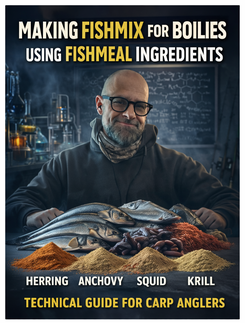
Advanced guide to selection and formulation in carp fishing fishmixes
Fishmeal as the biological engine of a boilie
In modern carp fishing, fishmeal is not just a protein ingredient — it is the primary nutritional carrier and feeding signal within a boilie.
Compared to plant-based ingredients, fishmeal:
- provides highly bioavailable amino acids and peptides
- generates a recognizable chemical signature for carp
- supports long-term feeding and learned behavior
👉 Key concept :
a fishmeal-based boilie works over time, not just instantly
Fishmeal as the biological engine of a boilie
Many anglers underestimate this.
Changing fishmeal does not just change an ingredient — it alters:
Amino acid profile
- variations in lysine, methionine, taurine
- direct impact on real palatability
Release speed
- soluble meals → fast release
- structured meals → slow release
Chemical signal (not just “flavour”)
- natural volatile compounds
- amines, peptides, nucleotides
👉 Practical result:
the same recipe behaves completely differently underwater
Types of fishmeal and their specific use in boilies
LT Fishmeal (Low Temperature)
Role in boilies:
- structural and nutritional base
Practical effects:
- improves dough consistency
- enhances water stability
- provides gradual nutrient release
Recommended inclusion:
👉 20–40% (up to 50% in pure fishmixes)
Best used for:
- long baiting campaigns
- pressured waters
- selective fishing
Predigested Fishmeal
Role:
- immediate activator
Effects:
- creates an instant attraction cloud
- accelerates initial feeding
Inclusion:
👉 5–15% (rarely above 20%)
Best for:
- cold water
- short sessions
- new spots
👉 Technical note:
it complements LT fishmeal — it does not replace it
Salmon Meal
Role:
- lipid source and energy
Effects:
- slows release
- increases caloric value
- improves texture
Inclusion:
👉 10–25%
Limitation:
- can reduce effectiveness in cold water if overused
Tuna Meal
Role:
- stronger feeding stimulus
Effects:
- effective in competitive environments
- enhances immediate response
Inclusion:
👉 10–20%
Anchovy / Sardine Meal
Role:
- balance between nutrition and attraction
Effects:
- stable, well-rounded profile
- excellent base alternative to LT
Inclusion:
👉 15–40%
Krill Meal
Role:
- multi-layered attractor
Effects:
- visual stimulation (astaxanthin)
- fast release
- strong feeding response
Inclusion:
👉 5–15% (up to 20% in dedicated mixes)
Squid Meal
Role:
- natural flavour marker
Effects:
- enhances bait identity
- improves signal persistence
Inclusion:
👉 5–10%
Crustacean Meals
Role:
- fast feeding trigger
Effects:
- strong initial stimulation
- increases competitiveness on the spot
Inclusion:
👉 5–15%
Advanced table: real function in boilies
| Type | Release speed | Boilie role | Fishing effect |
|---|---|---|---|
| LT fishmeal | slow | nutritional base | long-term feeding |
| Predigested | very fast | activator | instant response |
| Salmon | slow | energy source | selectivity |
| Tuna | medium | stimulus | competition |
| Anchovy | medium | balance | versatility |
| Krill | fast | attraction | curiosity |
| Squid | slow | identity | memory |
| Crustaceans | fast | trigger | immediate feeding |
Building a modern fishmix (practical application)
Typical structure:
- 15–30% LT fishmeal
- 5–10% secondary fishmeal (salmon / anchovy / tuna)
- 5% predigested fishmeal
- 5% krill or crustacean meal
- 5% squid meal
👉 This creates:
✔️ multi-phase release
✔️ complex chemical signalling
✔️ real nutritional value
Key synergies (practical mix design)
Fishmeal + Peanut
Why it works:
- balances protein and lipids
- improves workability
Practical use:
👉 10–20% peanut flour
Fishmeal + Yeast
Effect:
- increases palatability
- introduces nucleotides
👉 strong boost without altering structure
Fishmeal + MIXED SPICES (Robin Red)
Effect:
- amplifies taste signal
- improves diffusion
👉 ideal in pressured or coloured water
Fishmeal + Crustaceans
Effect:
- strong attraction synergy
- rapid feeding activation
👉 Core concept:
synergies work because they combine different amino acid availability speeds
Advanced strategy: multi-phase release boilies
A modern effective boilie is not uniform.
👉 It must include:
Phase 1 (instant)
- predigested
- crustaceans
- krill
Phase 2 (mid-term)
- tuna / anchovy
Phase 3 (long-term)
- LT fishmeal
- salmon
- squid
👉 This aligns with fish nutrition science:
- gradual release → better absorption
- continuous amino availability → sustained feeding
👉 Carp fishing translation:
carp return where they find consistent nutrition, not just attraction
Fishmeal quality: a critical factor
Not all fishmeal is equal.
⚠️ Key parameters:
- lipid oxidation
- biogenic amines
- raw material freshness
Scientific studies in aquaculture show:
- oxidized fishmeal reduces feed intake
- protein quality affects growth and health
- digestibility is critical for performance
👉 Practical translation:
low-quality fishmeal leads to poor long-term results — even if initially attractive
Time-release dynamics (core concept)
One of the most overlooked aspects in bait design is how nutrients are released over time.
Key principle
A boilie should not release everything immediately.
👉 It should create a sequence of signals over time
Simplified release curve
| Phase | Time | Components | Effect |
|---|---|---|---|
| Phase 1 | 0–2h | predigested, crustaceans, krill | instant activation |
| Phase 2 | 2–6h | tuna, anchovy | feeding maintenance |
| Phase 3 | 6–24h+ | LT fishmeal, salmon, squid | nutrition & conditioning |
Practical interpretation
- fast-soluble ingredients → start feeding
- medium components → hold fish
- slow components → build long-term response
👉 This explains why:
- overly soluble baits work fast but fade quickly
- overly hard baits fail to start
Common mistakes in fishmixes (and how to avoid them)
❌ 1 Too much fishmeal
Problem:
- overly dense mixes
- poor digestibility
- difficult rolling
Solution:
👉 balance with complementary ingredients
❌ 2 Treating all fishmeals as equal
Problem:
- flat, ineffective bait
Solution:
👉 combine:
- base (LT)
- activator (predigested)
- character (krill/squid)
❌ 3 Ignoring soluble fraction
Problem:
- slow bait response
Solution:
👉 include:
- predigested
- yeast
- soluble components
❌ 4 Excess fat (salmon-heavy mixes)
Problem:
- slow release
- reduced cold-water performance
Solution:
👉 balance with lean/soluble meals
❌ 5 Relying on flavours only
Problem:
- superficial attraction
- no long-term effectiveness
👉 Key concept:
fishmeal defines bait identity — not flavourings
❌ 6 Ignoring fishmeal quality
Indicators of poor quality:
- rancid smell
- dull colour
- “dead” powder texture
❌ 7 No formulation strategy
Problem:
- random mixes
- inconsistent results
👉 Solution:
design every mix based on:
- release dynamics
- nutritional profile
- ingredient function
Operational summary
An effective fishmeal boilie must:
✔️ include a nutritional base (LT fishmeal)
✔️ use activators (predigested / crustaceans)
✔️ provide progressive release
✔️ exploit synergies (yeast, Robin Red, peanut)
Advanced conclusion
The real difference in fishmixes is not how much fishmeal you use, but:
👉 how it behaves over time in water
A well-designed boilie:
- attracts immediately
- holds fish in the area
- builds feeding confidence
📗 Boilies, the Art and Science of Carp
Bait
→ scientific foundations and deeper understanding