
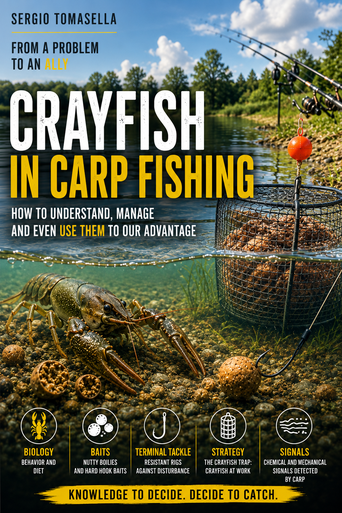
Understanding crayfish biology to turn one of the biggest nuisances in carp fishing into a powerful strategic advantage.
Crayfish are not the problem. They are the key to understanding where and how the biggest carp feed.
For many carp anglers, crayfish are nothing more than a nuisance, small crustaceans capable of quickly stripping hookbaits, breaking boilies apart, destroying a baited area and forcing us to check our rods constantly. They are often seen simply as an obstacle to overcome by using harder baits, larger diameters or defensive strategies.
In reality, this is an extremely limited way of looking at them.
Crayfish can certainly create serious problems, especially in waters where they reach very high densities, but before being a nuisance they are one of the most important natural food sources available to carp, and this is precisely where the greatest misunderstanding begins. For years we have focused almost exclusively on how to defend ourselves from crayfish, while overlooking a far more interesting question: why do the biggest carp spend so much time in waters where these crustaceans are abundant?
The answer is not simply the crayfish themselves, but the entire ecosystem that surrounds them. A bottom rich in crayfish is almost always biologically active, productive and full of benthic organisms, organic debris, microorganisms and continuous biological transformations. It is an environment where large carp can feed consistently, taking advantage of one of the richest natural food sources available from a nutritional point of view.
This completely changes the way we should interpret their presence. Our objective should not simply be to prevent crayfish from destroying our hookbaits, but to understand the complex chemical signals they generate and how even their constant activity on the lakebed may attract carp from considerable distances.
Throughout this article we will therefore overturn the traditional point of view. We will begin with crayfish biology and their extraordinary nutritional value for carp, analyse the differences between the native European crayfish and invasive species, understand when a crayfish-based boilie can become an exceptional weapon and when, instead, it is wiser to follow a completely different approach.
We will then move on to the practical side, presenting a boilie recipe specifically developed for fishing in crayfish-rich waters, highly resistant hookbaits, dedicated rigs and a little-known strategy that uses the activity of crayfish themselves to increase the attractiveness of your chosen swim.
Because, as we shall see, crayfish are never the real problem.
The real problem is how we choose to interpret them.
WHY CRUSTACEANS ARE PROBABLY THE BEST NATURAL FOOD AVAILABLE TO CARP
When discussing the natural diet of carp, most anglers immediately think of molluscs, insect larvae, worms, seeds falling into the water or aquatic vegetation. All of these are undoubtedly important food sources, but if I had to identify the animal group that probably represents the richest and most valuable natural food available to carp, I would choose crustaceans without hesitation.
That may sound like a bold statement, but a closer look at their composition quickly explains why.
Crustaceans are an extraordinary source of high biological value protein, rich in essential amino acids that are easily assimilated. They also provide a significant lipid fraction composed of fatty acids, phospholipids and sterols, all essential for the correct functioning of cell membranes. In addition, they contain vitamins, minerals and numerous trace elements that make them an exceptionally well-balanced natural food.
Even their exoskeleton, which at first glance appears of little nutritional interest, should not be considered waste. Chitin and the compounds produced during its degradation become part of a complex biological cycle involving bacteria, fungi and countless benthic organisms, contributing to the remarkable biological richness of the lakebed.
This is perhaps one of the most fascinating aspects of all.
Carp do not spend their lives searching for the single "best" food item. Their evolution has led them to identify environments capable of providing continuous feeding opportunities, safety and the highest possible return in terms of energy gained compared with energy spent searching for food.
For this reason, a bottom populated by crustaceans almost always represents an exceptionally attractive feeding area.
Where crayfish, small crustaceans and benthic organisms thrive, we rarely find a poor environment. On the contrary, these areas are generally rich in insect larvae, annelid worms, molluscs, bacterial biofilms, continuously transforming organic matter and intense microbiological activity.
In other words, crayfish are not simply a food source. They are one of the clearest indicators of a productive ecosystem, rather than the sole reason why large carp choose to frequent a particular area.
Understanding this concept is fundamental to everything that follows.
For decades we have tried to imitate crayfish through flavours, meals and extracts, when perhaps we should have paid much more attention to the biological context that their presence represents.
It may seem like a subtle distinction, but it has the potential to completely change the way we approach fishing in waters rich in crustaceans.
Before understanding how to exploit the presence of crayfish, however, we first need to understand these animals themselves.
Not all crustaceans behave in the same way and, above all, not all of them have the same impact on the environment or on our fishing.
WHICH CRUSTACEANS DO CARP FIND IN FRESHWATER AND BRACKISH ENVIRONMENTS?
When we say that carp feed on crustaceans, our thoughts almost immediately turn to freshwater crayfish. They are the most visible species, the ones we find clinging to our boilies, cutting through hookbaits and often forcing us to rethink an entire fishing strategy.
In reality, however, the world of crustaceans available to carp is far broader and varies considerably depending on the environment.
In lakes, slow-flowing rivers, canals and gravel pits we first encounter a wide variety of small benthic and planktonic crustaceans. Many of them are tiny and rarely regarded by anglers as a significant food source, yet for carp they can represent a constant supply of nutrition, especially when present in large numbers.
I am referring to amphipods such as freshwater shrimp (Gammarus spp.), small laterally compressed crustaceans that inhabit aquatic vegetation, stones, leaf litter and sediments. There are also freshwater isopods, with their flattened bodies closely associated with decomposing organic matter, together with copepods, cladocerans and many other microscopic organisms that form part of the plankton or the surface benthos.
Individually, these creatures may appear insignificant, but carp do not evaluate food in the same way we do.
Large carp spend hours filtering, sucking, blowing, re-sucking and sieving the lakebed. During this continuous feeding activity, even vast populations of tiny crustaceans become nutritionally important because they provide proteins, lipids, minerals, chitin, free amino acids and an entire range of chemical signals that carp have evolved to recognise.
Then we move on to the larger crustaceans, where the picture becomes even clearer.
Freshwater crayfish, whether native species or invasive ones, represent an exceptionally rich food source. They are not simply composed of muscle tissue. They also provide the hepatopancreas, exoskeleton, eggs carried by females, body fluids, fats, minerals, pigments and numerous odorous compounds that are released especially when the animal is injured, preyed upon, crushed or begins to decompose on the lakebed.
This is one of the main reasons why large carp are so frequently associated with areas where crayfish are abundant.
They are not necessarily searching for healthy adult crayfish to hunt like a true predator—although they are perfectly capable of doing so when the opportunity arises, as demonstrated by the many accidental captures made by anglers fishing for largemouth bass with soft plastic crayfish imitations.
More often, carp exploit biologically productive areas where they can find freshly moulted crayfish, dead individuals, body fragments, eggs, remains left behind by predators and the entire community of organisms living alongside them.
The picture becomes even more fascinating in brackish waters, estuaries, lagoons and river mouths, where carp may encounter an even greater diversity of crustaceans.
In these environments it is not unusual for carp to feed on small crabs, lagoon shrimp, schie (the traditional Venetian name for tiny grey lagoon shrimp), mud shrimps such as Upogebia pusilla—known locally as corbole—and many other decapod crustaceans adapted to life between fresh and salt water.
These brackish-water crustaceans deserve particular attention because they inhabit some of the most biologically productive ecosystems on Earth.
Estuaries, lagoons and river mouths are transition zones where freshwater, seawater, organic matter, plankton, microorganisms and soft sediments combine to create an extraordinary abundance of natural food. Carp that learn to exploit these habitats gain access to nutritional resources that are often far richer than those available in many inland waters.
This brings us to another aspect that, from my own experience, deserves much greater attention: pigmentation.
Many anglers have noticed that some large carp, especially those caught in waters rich in crustaceans, display intensely orange fins, darker lips, heavily pigmented mouths and much warmer overall colours than other fish from the same venue.
This is not simply an anglers' tale.
It is a biologically plausible relationship.
Crustaceans are naturally rich in carotenoids, particularly pigments such as astaxanthin and related compounds responsible for the red, orange and yellow colours found throughout the aquatic world.
Carp are unable to synthesise significant quantities of these pigments on their own. They acquire them through their diet and gradually deposit them in the skin, fins and other tissues. The intensity of this pigmentation depends on genetics, environmental conditions, physiological status and, above all, long-term feeding habits.
When we encounter old, heavily pigmented carp living in waters known to contain abundant crustaceans, the connection becomes extremely interesting.
This observation also leads us directly to one of the most famous—and often misunderstood—ingredients in the history of boilie making: the original Robin Red.
The genuine Robin Red did not remain successful for decades simply because it coloured baits red or because it contained spices.
It succeeded because it introduced into the bait a complex combination of spices, pigments, taste components and nutritional cues capable of producing savoury flavours, mild pungency, carotenoids and those subtle chemical signals associated with natural organic breakdown. Altogether, these sensory characteristics fit remarkably well within the biological context of waters where crustaceans form an important part of the carp's natural diet.
The same principle, with the necessary caution, can also be applied to the alternative blend that I have recommended for many years, based on paprika, triple concentrated tomato paste and monosodium glutamate.
Paprika contributes carotenoids together with a warm, spicy vegetable profile.
Triple concentrated tomato paste adds lycopene, organic acids, natural sugars, vegetable umami and an exceptionally rich liquid base.
Monosodium glutamate works on a different—but equally fundamental—level by reinforcing the savoury, protein-related taste associated with the natural breakdown of organic tissues.
In waters where crustaceans represent a major part of the natural food supply, a boilie built around vegetable pigments, glutamate, yeast, phospholipids, quality fats and a deep savoury profile can fit perfectly into that feeding environment without directly copying it.
This distinction is absolutely crucial.
Imitating a crayfish means offering something that is already present everywhere on the lakebed.
Interpreting crayfish, on the other hand, means understanding the nutritional, chemical and environmental signals associated with their presence, then designing a bait capable of integrating naturally into that ecosystem without becoming a poor imitation of the available food, while offering carp an alternative flavour profile that may prove even more appealing during periods of natural abundance.
The situation changes considerably during winter, when crayfish spend much of their time hidden in shelter and their availability as prey decreases dramatically.
But we shall come back to bait formulation shortly.
From this point onward, we can finally narrow our focus and examine crayfish themselves: first the native European freshwater crayfish, then the invasive Louisiana red swamp crayfish—two animals that anglers simply call "crayfish", yet from a biological, ecological and strategic point of view represent two completely different worlds.
THE NATIVE EUROPEAN CRAYFISH AND THE LOUISIANA RED SWAMP CRAYFISH: TWO CRUSTACEANS, TWO COMPLETELY DIFFERENT WORLDS
When we talk about crayfish in carp fishing, we often tend to place every species into the same category.
In reality, the word crayfish describes animals with profoundly different behaviours, ecological requirements and impacts on both the environment and our fishing. Understanding these differences allows us to interpret carp behaviour far more accurately.
Our native European freshwater crayfish belongs primarily to the genus Austropotamobius. It is a species closely associated with clean, well-oxygenated waters, natural substrates and relatively undisturbed habitats. It is extremely sensitive to pollution, habitat degradation and, above all, to crayfish plague, a disease introduced by invasive North American species that has caused the dramatic decline of native populations throughout much of Europe.
For this reason, the presence of native crayfish represents one of the most valuable biological indicators of environmental quality.
Where healthy populations of European crayfish still survive, we almost always find rivers, lakes or streams characterised by good oxygen levels, limited pollution and an ecosystem that remains relatively balanced.
For the carp angler, this is far more than an interesting biological fact.
It is valuable information.
An environment capable of sustaining native crayfish is usually rich in biodiversity, supports a healthy benthic community and offers an abundance of natural food. At the same time, experience has taught us that exceptionally clean waters require particular attention when formulating our baits. As I explained years ago in my book Boilies,the Art and Science of Carp Bait, and more recently in my article on the correct dosage of flavours and attractors, the cleaner the water, the more carefully we should balance the attractive liquid phase of our boilies, avoiding unnecessary overdosing.
The story is completely different when we move to the Louisiana red swamp crayfish (Procambarus clarkii), probably the invasive species that has altered the ecological balance of more European waters than any other freshwater crustacean.
Originally native to the southern United States, this crayfish possesses extraordinary adaptability.
It tolerates low oxygen levels, high temperatures, heavy turbidity, polluted environments and extreme seasonal fluctuations that would quickly eliminate our native species. It excavates deep burrows into banks, rapidly colonises new habitats and can reach population densities that European crayfish could never achieve.
From an ecological point of view, the consequences are enormous.
It preys upon amphibian eggs, juvenile fish, aquatic invertebrates and submerged vegetation while directly competing with numerous native species, profoundly altering the biological balance of entire aquatic ecosystems.
For carp anglers, the differences become immediately obvious.
Although native European crayfish certainly feed on our baits, they usually occur at much lower densities and rarely transform a baited area into a constant battlefield.
With the Louisiana red swamp crayfish, everything changes.
When populations become established, dozens—or even hundreds—of individuals may converge on the same baited area within a remarkably short time.
Boilies are continuously rasped away, pellets disappear rapidly, particles are shredded and hookbaits are subjected to relentless mechanical attack long before carp have the opportunity to find them.
It is precisely here that one of the greatest misconceptions begins.
Many anglers assume that, because crayfish are so abundant, carp must spend most of their time actively hunting them.
That is only partly true.
The reality is considerably more complex.
The Louisiana red swamp crayfish is far more aggressive, faster and significantly better equipped for defence than our native species.
Its powerful claws, extremely reactive behaviour and remarkable escape responses make capturing a healthy adult crayfish far from easy, even for a very large carp.
For this reason, carp rarely spend their time chasing vigorous adult crayfish.
Instead, they take advantage of freshly moulted individuals, juveniles, injured or weakened specimens, dead crayfish and, perhaps most importantly, the continuous supply of organic fragments produced by the colony itself.
This observation fundamentally changes the way we should interpret carp feeding behaviour.
Carp do not necessarily enter a crayfish colony simply to catch individual crayfish.
More often, they enter because that colony continuously produces an extraordinary quantity of secondary food resources: fragments of tissue, damaged individuals, eggs, prey remains, organic debris and countless metabolic by-products that constantly enrich the lakebed with chemical feeding signals.
This is the key concept that will guide the rest of this article.
If the native European crayfish tells us about the biological quality of a water, the Louisiana red swamp crayfish forces us to deal with a completely different ecosystem—one that has often been profoundly altered by its presence, yet paradoxically can still become an exceptionally productive feeding area for large carp.
WHEN CRAYFISH ARE A NUISANCE... AND WHEN THEY BECOME AN ALLY
At this point, some readers might think that I am almost trying to defend crayfish.
That is certainly not the case.
Anyone who has spent time fishing waters heavily populated by these crustaceans knows exactly how frustrating they can become. Boilies completely stripped within a few hours, hookbaits chewed until they lose all effectiveness, and rigs constantly disturbed by relentless crayfish activity are situations that countless carp anglers know all too well.
In some lakes and canals the problem becomes so severe that it completely changes the way we fish. We are forced to check our rods more frequently, use tougher baits, rethink our baiting strategy and, above all, design hookbaits capable of continuing to fish effectively even after hours of constant attack.
This is precisely where another common misunderstanding begins.
Most anglers see crayfish simply as animals that steal our bait.
In reality, their role is far more complex.
Crayfish do not merely consume food.
They cut it, shred it, transport it, break it apart and continuously reprocess the organic matter found on the lakebed. Every boilie they fragment, every pellet they consume and every particle they crack open immediately enters a biological transformation process that releases new food particles and fresh water-soluble compounds into the surrounding water.
From this perspective, crayfish are not merely consumers.
They are tireless processors of organic matter, constantly modifying and amplifying the feeding signals produced by our baiting campaign.
Consider, for example, an intact boilie resting on the bottom.
Its contact surface with the surrounding water is relatively limited, meaning the release of attractors occurs gradually over time.
Now imagine that same boilie being broken into dozens of fragments by crayfish.
Its exposed surface increases dramatically, accelerating the release of amino acids, peptides, sugars, organic acids and all the molecules responsible for what we generally define as primary attraction.
Exactly the same process occurs with every other source of organic matter present on the lakebed.
Plant debris, dead animals, molluscs, insect larvae and even crayfish themselves become part of a continuous cycle of fragmentation, digestion and nutrient release.
This leads us to a consideration that is rarely discussed in carp fishing.
Perhaps the greatest value of a crayfish colony is not represented by the crayfish themselves, but by the enormous amount of biological activity they generate every single day.
A dense colony keeps the lakebed in constant motion.
Nothing remains undisturbed for very long.
Everything is continuously broken down, reworked, shredded and returned to the environment as food particles, metabolic by-products and organic waste.
In other words, crayfish help create a biologically dynamic lakebed, permanently enriched with chemical signals that large carp have learned to recognise throughout their evolution.
It was precisely this observation that completely changed the way I interpret their presence.
I stopped asking myself only how to protect my baits from crayfish.
Instead, I began asking a much more interesting question:
How could I use the work these animals perform twenty-four hours a day to my own advantage?
WHY A CRAYFISH BOILIE IS NOT ALWAYS THE BEST CHOICE
Having reached this point, many anglers probably expect an obvious conclusion.
If large carp regularly feed on crustaceans, then surely the best possible bait must be a crayfish boilie.
In reality, things are far more complicated.
One of the most common mistakes in technical bait formulation is trying to reproduce as accurately as possible the natural food already available in the environment.
At first glance this seems perfectly logical.
However, it overlooks one fundamental aspect of carp feeding behaviour.
Carp live in dynamic ecosystems where the availability of natural food changes continuously according to season, water temperature, biological cycles and the overall balance of the aquatic environment.
Let's consider crayfish once again.
During the warmer months their activity increases dramatically.
They move more, feed more intensively, reproduce, moult frequently and, particularly in the case of the Louisiana red swamp crayfish, can reach extraordinary population densities.
Under these conditions, the lakebed is already saturated with the chemical signals associated with crustaceans.
Fragments of exoskeleton, body fluids, freshly moulted shells, dead individuals, metabolic waste and the constant biological processing of organic matter are present everywhere.
In other words...
the "crayfish message" is already everywhere.
This is precisely when a boilie designed solely to imitate crayfish may paradoxically lose part of its ability to stand out.
Not because it is a poor bait.
But because it attempts to reproduce a signal that nature is already providing in overwhelming abundance.
The situation changes completely with the arrival of late autumn and, above all, winter.
As water temperatures fall, crayfish metabolism slows significantly.
Their movements become more limited, moulting almost ceases and many individuals spend long periods sheltered within burrows or under cover.
Consequently, the amount of crustacean-derived chemical signals released into the environment decreases considerably.
It is during this period that a boilie built around crustacean-derived ingredients can once again become exceptionally effective, presenting carp with a highly desirable food source that has become much less available naturally.
This does not mean that crayfish boilies only work during winter.
It means that the effectiveness of any bait depends not only on its composition, but also on the natural availability of the same food source within the environment where we are fishing.
This realisation fundamentally changed the way I formulate my own baits.
Whenever I fish waters rich in crayfish—or, more generally, waters rich in natural food—I rarely try to copy the dominant food source directly.
Instead, I prefer to place my bait within the same biological context while following a different route.
My objective is to create a satisfying food item capable of encouraging prolonged feeding behaviour, while using chemical signals that are fully compatible with that ecosystem without simply duplicating what is already present.
It may sound like a philosophical distinction.
In reality, it completely changes the entire bait design process.
In waters dominated by crustaceans, I prefer to offer a boilie built around yeast, phospholipids, highly digestible proteins, quality vegetable fats, glutamate, natural carotenoids, carefully selected spices and a discreet yet highly distinctive aromatic profile.
The carp still recognises a food source that fits perfectly within the biological environment in which it is feeding.
At the same time, however, it receives a different stimulus from the one it encounters continuously across the lakebed.
Exactly the same principle can be observed throughout nature.
Animals do not necessarily seek the most abundant food available.
Very often they select the food source that offers the best balance between availability, nutritional value, ease of detection...
...and taste.
Yes, taste.
Because very large carp often fall for the food they simply enjoy eating the most.
It was precisely this line of reasoning that eventually led me to develop the boilie recipe I have been using for many years in waters rich in crayfish:
a boilie specifically designed to fish where crayfish live—not to imitate them.
A SUMMER BOILIE FOR CRAYFISH-RICH WATERS
At this point, many readers may be wondering what kind of bait I actually choose when fishing waters where crayfish are both abundant and highly active.
As I explained in the previous chapter, I prefer not to imitate the dominant natural food source directly.
Instead, I try to offer something that fits perfectly within the same nutritional context while remaining sufficiently different to stimulate the carp's curiosity.
This recipe was developed with exactly that philosophy in mind.
Its objective is twofold.
On one hand, it provides carp with a highly nutritious, digestible bait rich in water-soluble feeding signals.
On the other, it deliberately avoids turning itself into an irresistible food source for crayfish.
This distinction is fundamental.
Many classic fishmeal or liver-based boilies contain exactly the type of highly attractive animal-derived compounds that crayfish naturally seek. Fish proteins, fresh liver derivatives, marine meals and similar ingredients often become primary feeding targets for dense crayfish populations long before carp arrive.
The aim of this formulation is different.
Rather than competing directly with the natural food already dominating the lakebed, it offers carp an alternative feeding opportunity built around yeast, vegetable proteins, carefully selected fats, savoury taste enhancers and subtle fermentation notes. It is a boilie that sits comfortably within the same biological environment without becoming another obvious crustacean meal.
Dry Mix
- 30% re-milled durum wheat semolina
- 30% inactive feed-grade brewer's yeast
- 20% full-fat soybean flour
- 10% roasted peanut flour
- 10% WPC 80 (Whey Protein Concentrate)
The nutritional profile of this mix is remarkably balanced.
Overall crude protein content is approximately 36–38%, depending on the analytical values of the individual raw materials, while the lipid fraction remains moderate, with an excellent contribution from phospholipids and highly digestible vegetable fats.
Every ingredient has been selected for a specific reason.
The semolina provides the structural framework of the bait. Its gluten-forming capacity produces a cohesive dough that rolls easily and develops excellent mechanical strength after boiling.
Inactive brewer's yeast forms the nutritional heart of the recipe. Besides contributing high-quality protein, it supplies B vitamins, nucleotides, peptides, natural glutamates and countless compounds produced during yeast metabolism. It also gives the bait a deep savoury taste that large carp readily accept.
Full-fat soybean flour contributes both nutritionally and mechanically. Its proteins, phospholipids and emulsifying properties help create a homogeneous dough while improving the dispersion of the liquid ingredients throughout the mix.
Roasted peanut flour introduces another dimension entirely.
Its pleasant roasted flavour, combined with high-quality vegetable fats and additional protein, produces a distinctive profile that differs markedly from the animal-based feeding signals already dominating crayfish-rich waters.
Finally, WPC 80 increases both the biological value of the protein fraction and the physical strength of the finished boilie, helping it maintain excellent resistance during prolonged immersion.
As with every high-quality bait, I recommend preparing the dough with eggs straight from the refrigerator, or even slightly colder when possible. Keeping the mixture cool during preparation improves dough consistency and helps preserve the functional properties of several sensitive ingredients.
Liquid Phase
- 50 ml 100% peanut butter
- 30 ml triple concentrated tomato paste
- 20 g paprika
- 10 g monosodium glutamate
- 6 drops red thyme essential oil
- 2 drops butyric acid
The liquid phase is what gives this bait its true personality.
Peanut butter provides highly digestible vegetable fats together with an unmistakable roasted aroma that blends perfectly with the peanut flour already present in the mix.
Triple concentrated tomato paste contributes far more than colour.
It supplies natural sugars, organic acids, lycopene, vegetable umami and an exceptionally rich soluble fraction that diffuses rapidly into the surrounding water.
Paprika reinforces both the pigment profile and the warm spicy notes while adding further carotenoids that integrate naturally with the overall concept of the bait.
Monosodium glutamate performs a central role.
Rather than acting as a simple flavour enhancer, it reproduces one of the most important savoury signals associated with the natural breakdown of protein-rich organic matter, creating a taste profile that carp recognise instinctively.
The red thyme essential oil gives the bait remarkable personality. Used at this dosage, it never dominates the formulation but adds depth and complexity while working in perfect synergy with the savoury ingredients.
Finally, two drops of butyric acid introduce a subtle fermented background note that completes the overall sensory profile without overwhelming the rest of the formulation.
The result is a boilie that deliberately avoids becoming a "crayfish bait".
Instead, it becomes a carp bait designed for crayfish-rich waters.
That difference may appear subtle.
In reality, it is the entire philosophy behind this recipe.