
How Far Can Carp Detect a Boilie?
Many carp anglers imagine carp following invisible scent trails created by flavours and attractors until they eventually reach our rigs.
But how far away can a carp actually detect the chemical signals released by a boilie?
The answer is more complex than many people think.
Attraction Starts with the Boilie Structure
First of all, we must assume that the boilie is properly made.
A poorly produced bait with an external crust of gelled starch can dramatically reduce the movement of attractors in and out of the bait itself.
If the structure is too sealed, the release of soluble substances becomes extremely limited.
In a properly balanced bait, however, liquids and soluble ingredients can gradually diffuse into the surrounding water and create a feeding signal.
Different Liquids Behave Differently
Everything we add in liquid form is technically designed to create attraction by leaking out of the bait over time.
But not all liquids behave in the same way.
Generally speaking:
* Thin and highly soluble liquids disperse quickly
* Dense liquid foods move more slowly
* Sticky extracts release gradually
* Oils are even slower
* Sweeteners often disperse very easily
This is fundamentally a question of solubility.
That’s why a properly designed technical bait should always contain ingredients with different release speeds. The goal is to create a layered attraction profile capable of working continuously for 10–15 hours — which is more or less the ideal active lifespan of a 20mm boilie.
Concentration Makes a Huge Difference
Another major factor is the internal concentration of attractors inside the bait.
The higher the concentration of soluble substances, the stronger the outward diffusion into the water.
For example:
* 50ml of dense liquid food per kg of mix creates mainly a taste effect
* 100–200ml per kg produces a much stronger attractive signal
The amount of bait introduced into the swim obviously matters as well.
A single hookbait with a few boilies on a stringer creates a very limited attraction zone compared to several kilos of crushed boilies spread across the lakebed.
All these factors combine to determine both the strength and duration of the chemical signals reaching the fish.
So How Far Can a Carp Smell a Boilie?
To simplify the concept, let’s imagine a high-quality hunting boilie like the ones described in my book [Boilies by The Bait Guru](https://www.thebaitguru.it?utm_source=chatgpt.com).
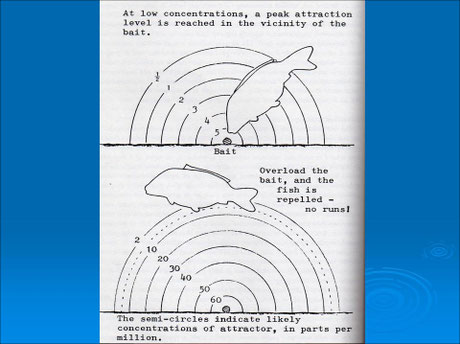
If we estimate the amount of soluble substances released during the first five hours of immersion, we can realistically assume that after around 30 minutes the effective attraction zone of a single boilie is relatively small.
In practical terms, we are talking about roughly a cubic metre of water around the bait.
That means approximately:
* 50cm upward
* 50cm sideways
* Slightly more along the bottom
This happens because many organic substances have a neutral or slightly heavier density than water and tend to remain closer to the lakebed.
The Real Lesson
Taken to the extreme, this concept teaches us something very important:
If you are fishing with only a single hookbait and no free offerings around it, the bait must be placed extremely close to the route the carp are already likely to travel.
Carp are not magically detecting single boilies from dozens of metres away.
Location still remains king.
Attractors help the fish make the final decision once they enter the effective feeding zone — but first, the carp still need to pass close enough to detect the signal.
In my book you can find detailed explanations of both chemical and natural attractors used in modern carp bait design.